
Pronouns are a normal part of everyday language. We use them all the time without even thinking about it. But sometimes, a simple pronoun can become the center of a hilarious joke.
If you are searching for funny pronoun jokes, you are in the right place. Whether you want a clever one liner, a classroom friendly joke, or something to make friends smile, this guide has plenty of laughs waiting for you.
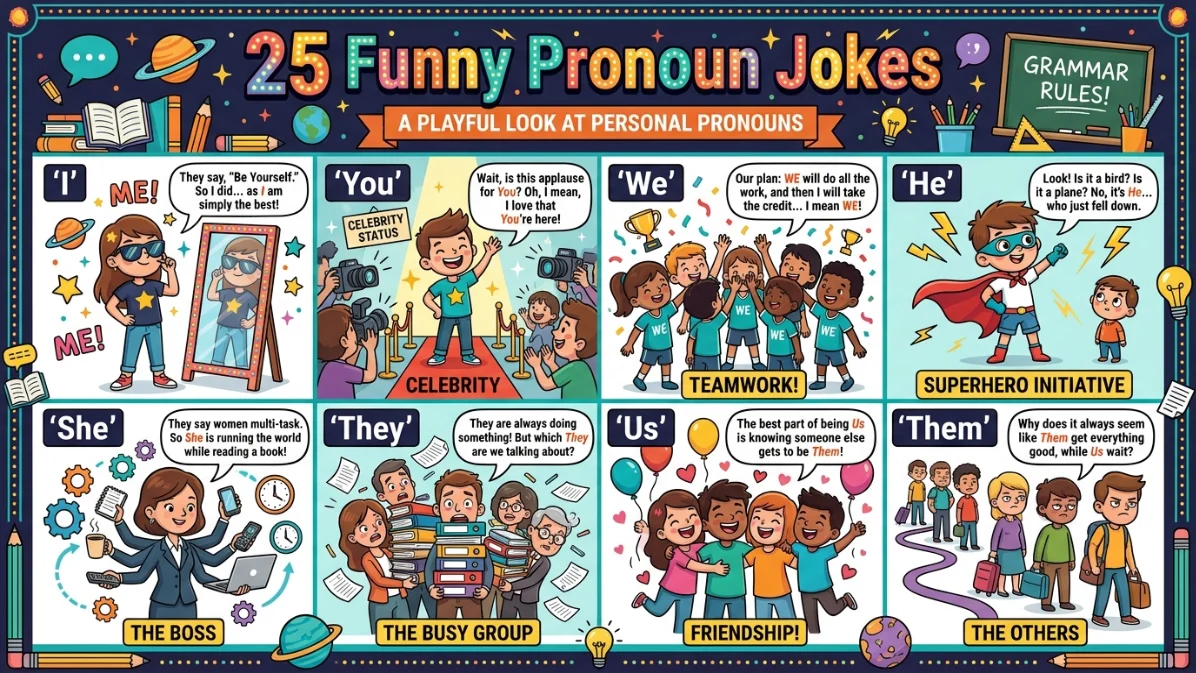
In this article, you will find 25 funny pronoun jokes, each with a mini story, a bold example, and tips on when to use it and when not to use it. Get ready for some lighthearted wordplay that proves grammar can actually be funny.
What Does Funny Pronoun Jokes Mean?
Funny pronoun jokes are jokes that use words like he, she, they, we, I, you, us, and them in a playful or unexpected way.
These jokes often:
- Use grammar humor
- Create funny misunderstandings
- Turn ordinary conversations into laughs
- Work well in classrooms and social settings
The best pronoun jokes are simple, clever, and easy for everyone to understand.
25 Funny Pronoun Jokes
1. The Pronoun That Wanted Attention
Scenario: During a grammar lesson, the teacher asked if anyone knew what a pronoun was. One student raised a hand and said pronouns are like celebrities because they are always standing in for someone else. The whole class laughed because the answer was surprisingly accurate. Sometimes the funniest jokes come from simple observations that everyone understands.
“Pronouns are the backup singers of grammar.”
“They do all the work but never get the spotlight.”
✔ Use when: Talking about grammar in a fun way
❌ Don’t use when: Someone needs a serious grammar explanation
2. I Am Very Important
Scenario: A student looked at a sentence and noticed the word “I” appeared several times. He joked that the pronoun “I” must think it is the most important word in the dictionary. Everyone laughed because it sounded exactly like someone with a huge ego introducing themselves.
“The pronoun I never misses a chance to talk about itself.”
“Some things never change.”
✔ Use when: Sharing simple wordplay
❌ Don’t use when: Discussing serious writing feedback
3. We Are a Team
Scenario: During a group project, one student said the pronoun “we” should win an award because it always brings people together. The joke instantly made the group smile and helped lighten the mood before the presentation.
“We is the most social pronoun.”
“It never likes working alone.”
✔ Use when: Team activities and projects
❌ Don’t use when: Someone is upset about teamwork
4. They Are Everywhere
Scenario: A teacher asked for examples of pronouns. One student replied that “they” is the busiest pronoun because it seems to show up in every conversation. The class laughed because it felt surprisingly true.
“They must earn overtime pay.”
“They are working in every sentence.”
✔ Use when: Classroom humor
❌ Don’t use when: Serious discussions about language
5. You Look Familiar
Scenario: A friend said the pronoun “you” must be famous because everybody keeps talking about it. The joke was simple, but its silliness made everyone laugh.
“You is the celebrity of grammar.”
“Everyone keeps mentioning you.”
✔ Use when: Casual conversations
❌ Don’t use when: Formal presentations
6. He Lost His Job
Scenario: A student joked that the pronoun “he” got fired because nouns started doing their own work. The ridiculous image of a pronoun applying for jobs made everyone laugh.
“He was replaced by the original noun.”
“Tough day at the grammar office.”
✔ Use when: Sharing wordplay jokes
❌ Don’t use when: Discussing real job losses
7. She Solved the Mystery
Scenario: During a grammar exercise, a student claimed the pronoun “she” should become a detective because she always helps identify who everyone is talking about.
“She always finds the missing noun.”
“Case closed.”
✔ Use when: Light classroom humor
❌ Don’t use when: Serious educational testing
8. Us Means Trouble
Scenario: Two friends kept getting blamed for harmless pranks. One joked that the pronoun “us” must attract trouble because people always say, “It was us.”
“Us never stays out of trouble.”
“The evidence is everywhere.”
✔ Use when: Joking with friends
❌ Don’t use when: Real blame is involved
9. Them Again
Scenario: A teacher noticed students always used “them” in examples. One student joked that “them” deserves an acting award because it appears in every story.
“Them is booked and busy.”
“A true grammar superstar.”
✔ Use when: Casual educational humor
❌ Don’t use when: Formal writing lessons
10. The Lazy Pronoun
Scenario: Someone asked why pronouns exist. A friend quickly replied that nouns got tired of repeating themselves all day.
“Pronouns were invented by tired nouns.”
“Even grammar needs shortcuts.”
✔ Use when: Explaining pronouns humorously
❌ Don’t use when: Detailed grammar instruction
11. We Need a Vacation
Scenario: A student looked at a paragraph filled with pronouns and joked that they must be exhausted after carrying the whole story.
“These pronouns deserve paid leave.”
“They have been working nonstop.”
✔ Use when: Classroom fun
❌ Don’t use when: Academic exams
12. I Won the Argument
Scenario: During a grammar debate, someone declared that “I” wins every argument because it always puts itself first.
“I always comes first.”
“At least in its own mind.”
✔ Use when: Friendly wordplay
❌ Don’t use when: Real arguments
13. You Again
Scenario: A friend noticed every example sentence included “you.” They joked it must have hired a great agent.
“You never misses an appearance.”
“Talk about job security.”
✔ Use when: Casual humor
❌ Don’t use when: Professional training
14. He Has Confidence
Scenario: Someone joked that the pronoun “he” walks into every sentence like it owns the place.
“He enters every sentence confidently.”
“Main character energy.”
✔ Use when: Lighthearted grammar jokes
❌ Don’t use when: Serious language discussions
15. She Is Organized
Scenario: During a grammar lesson, a student claimed “she” always knows where the noun is hiding.
“She keeps grammar organized.”
“Someone has to do it.”
✔ Use when: Classroom humor
❌ Don’t use when: Formal assessments
16. They Never Rest
Scenario: A teacher pointed out how often “they” appears. A student replied that “they” must never sleep.
“They are working every shift.”
“Grammar’s hardest worker.”
✔ Use when: Educational fun
❌ Don’t use when: Serious grammar reviews
17. We Did Our Best
Scenario: A group project went badly. One student smiled and said at least the pronoun “we” tried its best.
“We deserves participation trophies.”
“Effort counts too.”
✔ Use when: Lightening disappointment
❌ Don’t use when: Serious failure discussions
18. Us Against the World
Scenario: Two friends were joking around and claimed “us” sounds like the name of a superhero team.
“Us assembles at sunrise.”
“Saving grammar daily.”
✔ Use when: Friendly conversations
❌ Don’t use when: Formal events
19. Them Took the Credit
Scenario: Someone joked that “them” always shows up after the hard work is done.
“Them arrived for the applause.”
“Perfect timing.”
✔ Use when: Casual jokes
❌ Don’t use when: Workplace conflicts
20. You Are Everywhere
Scenario: A student counted examples in a textbook and noticed “you” appeared constantly.
“You has excellent attendance.”
“Never misses class.”
✔ Use when: School humor
❌ Don’t use when: Formal lectures
21. I Need a Break
Scenario: A writer used “I” repeatedly and joked that it deserved a vacation.
“I has been carrying this story.”
“Someone get it a chair.”
✔ Use when: Writing jokes
❌ Don’t use when: Professional editing
22. He Found the Noun
Scenario: A student imagined “he” searching for nouns like a treasure hunter.
“He found the missing noun.”
“Adventure complete.”
✔ Use when: Classroom fun
❌ Don’t use when: Tests and exams
23. She Loves Grammar
Scenario: Someone joked that “she” reads grammar books for fun.
“She has grammar on speed dial.”
“Always prepared.”
✔ Use when: Educational humor
❌ Don’t use when: Serious lessons
24. They Run the World
Scenario: A student noticed “they” appears almost everywhere in modern writing.
“They secretly run grammar.”
“The evidence is overwhelming.”
✔ Use when: Friendly grammar discussions
❌ Don’t use when: Academic analysis
25. The Pronoun Reunion
Scenario: Imagine all pronouns meeting at a giant reunion party. “I” talks about itself, “we” makes friends, and “they” arrives late because it was busy appearing in other sentences. The image alone is enough to make people smile.
“The pronouns had a reunion.”
“I still talked the most.”
✔ Use when: Ending a grammar lesson with humor
❌ Don’t use when: Serious educational assessment
Top 10 Editor’s Choice Pronoun Jokes
- Pronouns are the backup singers of grammar.
- The pronoun I never misses a chance to talk about itself.
- We is the most social pronoun.
- They must earn overtime pay.
- You is the celebrity of grammar.
- Pronouns were invented by tired nouns.
- These pronouns deserve paid leave.
- They are working every shift.
- Us assembles at sunrise.
- The pronouns had a reunion.
FAQs
1. What are funny pronoun jokes?
Funny pronoun jokes are jokes that use pronouns and grammar concepts to create humor through clever wordplay.
2. Are pronoun jokes suitable for kids?
Yes. Most pronoun jokes are clean, educational, and easy for children to understand.
3. Can teachers use pronoun jokes in class?
Absolutely. They make grammar lessons more engaging and memorable.
4. Why do grammar jokes make people laugh?
They turn ordinary language rules into funny and unexpected situations.
5. Are pronoun jokes good for social media?
Yes. Short pronoun jokes work well as captions, posts, and memes.
6. Can pronoun jokes help students learn?
Yes. Humor often helps people remember concepts more easily.
7. What makes a good pronoun joke?
A good pronoun joke is simple, clever, easy to understand, and relatable.
Final Thoughts
Grammar does not have to be boring. With the right joke, even a simple pronoun can become the star of the conversation.
These funny pronoun jokes prove that words like I, you, we, they, he, and she can do more than build sentences. They can also create laughter.
The next time someone says grammar is dull, share one of these jokes and watch their opinion change.