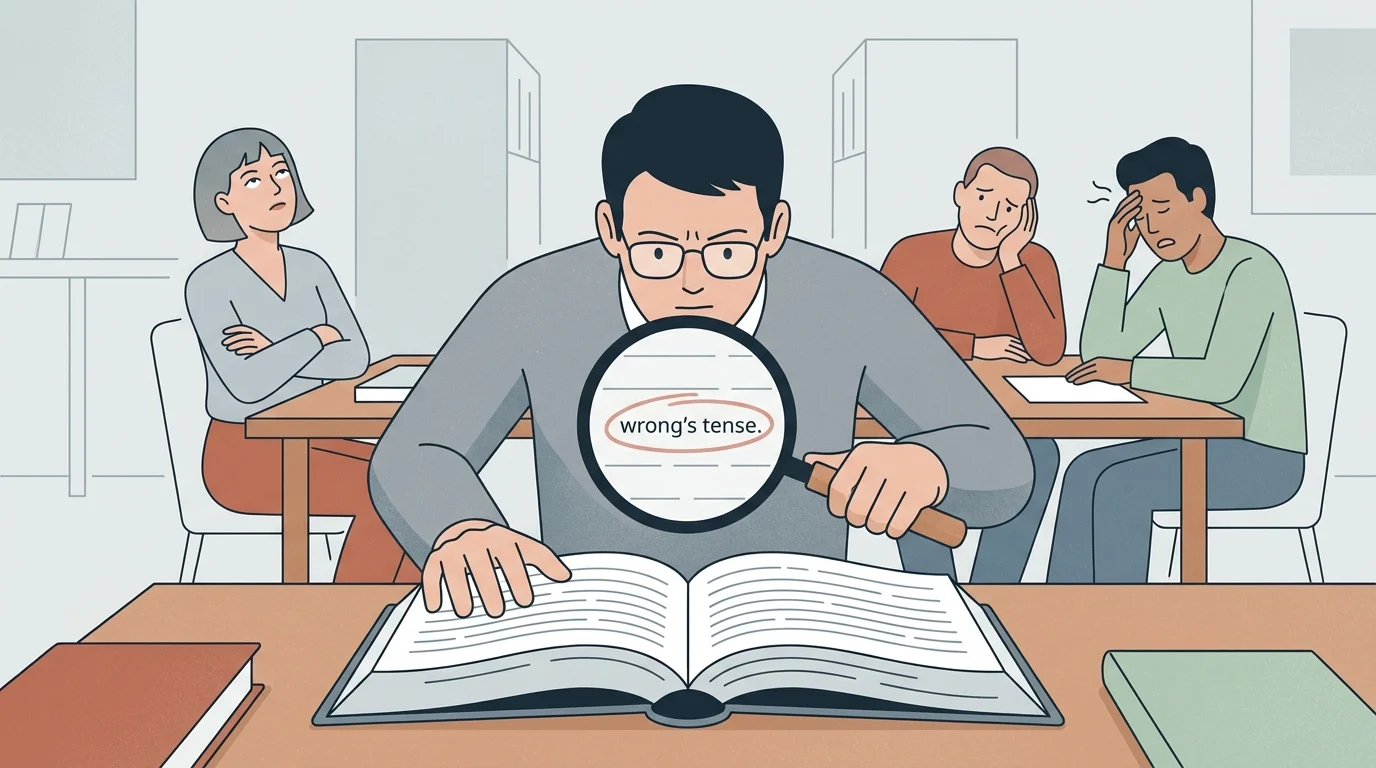

Pedantic means being overly concerned with minor details, formal rules, or literal accuracy in a way that comes across as annoying or showy. It describes someone who corrects small errors, obsesses over trivial points, and displays learning in an ostentatious manner. The term has a negative connotation and is often used to describe people who prioritize minutiae over broader understanding.
Have you ever been in a conversation where someone constantly corrects your grammar, points out minor factual errors, or goes on a lengthy tangent about an obscure detail nobody asked about? If so, you have encountered pedantic behavior.
The word “pedantic” gets thrown around quite a bit, but many people aren’t entirely sure what it means or how to use it correctly. Is it the same as being precise? Is it always a bad thing? And how can you tell if someone is being pedantic versus just thorough?
This guide covers everything you need to know about the pedantic meaning, from its definition and origins to real-life examples, platform-specific usage, and tips for dealing with pedantic people. By the end, you will understand exactly what it means to be pedantic and how to recognize it in everyday life.
Quick Answer
| Element | Details |
|---|---|
| Meaning | Overly concerned with minor details, formal rules, or literal accuracy |
| Context | Usually used negatively to describe annoying, nitpicky behavior |
| Usage | Adjective describing a person, comment, or approach |
| Platforms | Social media, workplace communication, academic settings, casual conversation |
| Example | “His pedantic corrections made the meeting unbearable.” |
| Tone | Negative, critical, dismissive |
What Does Pedantic Mean?
At its core, the pedantic meaning refers to someone who is excessively focused on minor details, formal rules, or literal accuracy. A pedantic person often corrects small errors, obsesses over trivial information, and displays their knowledge in a way that feels showy or tiresome to others.
The term comes from “pedant,” which originally meant “schoolmaster” or “teacher.” Over time, however, the word took on a negative connotation. Today, calling someone pedantic is almost always an insult. It suggests that the person cares more about being technically correct than about communicating effectively or understanding the bigger picture.
Merriam-Webster defines pedantic as “being a person who annoys other people by correcting small errors and giving too much attention to minor details” or “narrowly, stodgily, and often ostentatiously learned.”
Key Characteristics of Pedantic Behavior
Pedantic people tend to:
- Correct others’ grammar, pronunciation, or word choice, even in casual conversation
- Overemphasize formal rules and procedures
- Display knowledge in an ostentatious or showy manner
- Focus on trivial points rather than the main idea
- Use overly technical or complicated language
- Struggle to see the bigger picture because they are too focused on details
Full Definition
The pedantic definition can be broken down into several layers:
Adjective: Overly concerned with minute details or formalisms, especially in teaching.
Negative Connotation: The term implies that someone is showing off book learning or trivia in a tiresome way.
Origin: First recorded in 1590–1600, from the word “pedant” meaning “schoolmaster.”
Synonyms: Fussy, nit-picky, pretentious, pompous, bookish, didactic, finicky
Antonyms: Broad-minded, casual, easygoing, flexible, unpretentious
It is important to note that pedantic is almost always used disapprovingly. There is no neutral or positive way to call someone pedantic. The word itself carries judgment.
Context and Usage
When Is Someone Called Pedantic?
People are called pedantic in a variety of situations, but the common thread is that their attention to detail feels excessive, unnecessary, or annoying.
In academic settings: A professor who spends an entire lecture correcting the proper use of semicolons rather than discussing the novel’s themes might be called pedantic.
casual conversation: Someone who constantly interrupts to correct grammar, like pointing out that “less” should be “fewer,” is being pedantic.
In the workplace: A colleague who insists on following every procedure to the letter, even when it slows down progress, might be described as pedantic.
Online: Internet commenters who correct typos or minor factual errors rather than engaging with the main point are often accused of being pedantic.
Pedantic vs Precise
It is easy to confuse pedantic with precise, but there is an important difference.
Precise means being accurate, exact, and careful. It is generally a positive quality. A surgeon needs to be precise. An engineer needs to be precise. Precision shows professionalism and attention to what matters.
Pedantic, on the other hand, means being overly concerned with trivial details. It is about correcting minor things that don’t actually matter.
The distinction comes down to relevance and proportion. Being precise about something important is good. Being pedantic about something trivial is annoying.
Pedantic vs Didactic
These two words are often confused, but they have different meanings.
Didactic means intended to teach, especially with a moral lesson. A didactic person wants to instruct others, often in a way that feels preachy.
Pedantic means being overly focused on minor details and rules. A pedantic person wants to be technically correct, even if it means missing the bigger picture.
Someone can be both pedantic and didactic. For example, a teacher who both lectures too much and corrects every minor mistake is displaying both traits.
However, didactic is not always negative. It can simply refer to instructional content. Pedantic, in contrast, is almost always negative.
Pedantic vs Erudite
Erudite means having or showing great knowledge. It is a compliment. An erudite person is well-read and scholarly.
Pedantic means showing off knowledge in an annoying way. A pedantic person has knowledge but uses it to feel superior rather than to help others.
The difference is in delivery. An erudite person shares knowledge generously. A pedantic person corrects others to prove they are smarter.
Real-Life Examples
1: The Grammar Police
Friend 1: “I could care less about what he thinks.”
Friend 2: “Actually, you mean you couldn’t care less. If you could care less, that means you care at least a little.”
Friend 1: “You know what I meant.”
Friend 2: “I’m just saying, words have meanings.”
In this example, Friend 2 is being pedantic. They understood the intended meaning but chose to correct a minor linguistic detail instead of engaging with the conversation.
2: The History Buff
Person A: “Shakespeare was such a genius writer.”
Person B: “Well, actually, many scholars debate whether Shakespeare actually wrote all the plays attributed to him. There is the Oxfordian theory, the Marlovian theory…”
A: “I just meant I like his plays.”
B: “But if we are being accurate, we should acknowledge the authorship question.”
person B is being pedantic by derailing a simple compliment with obscure historical trivia.
3: The Technology Stickler
Colleague 1: “Can you send me that file?”
Colleague 2: “It is not a file, it is a folder. Files contain data; folders contain files.”
Colleague 1: “Can you send me the folder?”
Colleague 2: “I cannot send a folder directly. I would need to compress it first.”
This exchange shows how pedantic behavior can hinder communication and frustrate others.
4: The Recipe Corrector
Cook: “Add a pinch of salt.”
Pedantic friend: “A pinch is not a standardized measurement. It typically ranges from 1/16 to 1/8 of a teaspoon depending on the ingredient. You should be more specific.”
Cook: “It is just a recipe. A pinch is fine.”
Pedantic friend: “Precision matters in cooking.”
5: The Movie Critic
Viewer: “That movie was set in the 1980s.”
Pedantic friend: “Actually, it was set in 1987 specifically. The soundtrack includes a song that was released in 1987, and the car model was only produced from 1985 to 1988. So it could not have been any earlier than 1987.”
Viewer: “I was just giving a general time period.”
Pedantic friend: “Accuracy matters.”
Platform-Specific Meaning
On WhatsApp, pedantic behavior often appears in group chats. Someone might correct a typo, point out a misplaced comma, or fact-check a meme. In informal settings, this can come across as annoying and socially tone-deaf. Most WhatsApp conversations are casual, so pedantic corrections feel unnecessary and out of place.
Snapchat
Snapchat is all about quick, casual communication. Pedantic behavior does not fit well here. Someone who corrects a friend’s spelling in a Snap or points out a minor error in a quick video is likely to be seen as missing the point of the platform. Snapchat is for sharing moments, not for nitpicking.
TikTok
On TikTok, pedantic comments often appear in the comment section. Users might correct a creator’s pronunciation, point out a factual error in a video, or argue about minor details. Because TikTok content is fast-paced and entertainment-focused, pedantic comments are often mocked or dismissed as “um, actually” behavior.
Twitter / X
Twitter has a reputation for being a haven for pedantic behavior. The platform’s text-based nature and public format encourage people to correct each other constantly. Threads often devolve into arguments about minor points rather than substantive discussion. Being pedantic on Twitter is so common that it has become a running joke.
On LinkedIn, pedantic behavior can be more subtle. Someone might correct a professional term, point out a minor grammatical error in a post, or argue about industry-specific terminology. Because LinkedIn is a professional platform, pedantic behavior can damage credibility and make someone look difficult to work with.
Reddit is a mixed bag. Some subreddits encourage precision and detailed discussion, where being pedantic might be acceptable or even valued. In other subreddits, pedantic comments are downvoted and criticized. The platform’s voting system often punishes pedantry by hiding it from view.
In-Person Conversations
In face-to-face interactions, pedantic behavior is often more obvious and more annoying. There is no screen to hide behind. A pedantic person who interrupts or corrects others in person can quickly become socially isolated. Nonverbal cues like eye-rolling, sighing, and looking away signal that the behavior is unwelcome.
Alternative Meanings
While “pedantic” has a fairly consistent definition, it can take on slightly different shades of meaning depending on the context.
In academic writing: Pedantic might describe a style that is overly formal, dense, and focused on minor points rather than clear communication.
teaching: Pedantic describes an approach that emphasizes rules and details over understanding and application.
casual speech: Pedantic is used to describe anyone who corrects others or shows off knowledge in an annoying way.
literature: Pedantic characters are often used as comic relief or as villains who are unlikeable due to their obsessive focus on details.
In criticism: Calling someone pedantic is a way to dismiss their argument by suggesting they are missing the point.
There is also a less common usage where pedantic simply means “scholarly” or “bookish,” but this usage is outdated. Today, the negative connotation is firmly attached.
Related Terms and NLP Variations
Understanding the pedantic meaning also means understanding related words and how they differ.
| Term | Meaning | Connotation |
|---|---|---|
| Pedantic | Overly concerned with minor details | Negative |
| Precise | Accurate and exact | Positive |
| Didactic | Intended to teach, often moralizing | Mixed |
| Erudite | Having great knowledge | Positive |
| Punctilious | Showing great attention to detail | Mixed |
| Fastidious | Very attentive to detail | Mixed |
| Nit-picky | Overly critical of small details | Negative |
| Bookish | Devoted to reading and study | Neutral |
| Ostentatious | Showy, designed to impress | Negative |
Semantic variations:
- “That is a pedantic distinction” = That difference is too minor to matter
- “Do not be pedantic” = Stop focusing on trivial details
- “Pedantic about grammar” = Obsessively focused on grammatical correctness
- “Pedantic lecture” = A boring, detail-focused talk
Common collocations:
- Pedantic attention to detail
- Pedantic correction
- Pedantic argument
- Pedantic tone
- Pedantic style
How to Respond to Pedantic Behavior
When you encounter someone being pedantic, how you respond depends on the situation and your relationship with the person.
Acknowledge and Move On
Sometimes the easiest response is to acknowledge the point and move on. For example:
“That is a fair point, but what I was really trying to say is…”
This validates their need to be correct while steering the conversation back to the main topic.
Use Humor
Humor can diffuse tension. For example:
“Alright, grammar police. Can I continue my story now?”
This lightly calls out the behavior without being aggressive.
Be Direct
If someone is consistently pedantic and it is bothering you, it might be worth addressing directly. For example:
“I appreciate your attention to detail, but sometimes I just want to have a casual conversation without being corrected.”
Ignore It
Sometimes the best response is no response. Engaging with pedantic comments often encourages more pedantic behavior.
Redirect to the Bigger Picture
When someone focuses on a minor detail, you can redirect:
“That is an interesting point, but what do you think about the overall idea?”
When You Might Be the Pedantic One
If you find yourself constantly correcting others or focusing on minor details, ask yourself:
- Does this detail actually matter?
- Is this the right time and place?
- Am I helping or just showing off?
- Will the other person appreciate this correction?
Sometimes being precise is valuable. But if you are annoying people, you might be crossing into pedantic territory.
Misinterpretations
There are several common misunderstandings about the pedantic meaning.
1: Pedantic Means Smart
Some people think being pedantic means being intelligent. In reality, pedantic behavior often shows a lack of social intelligence. Truly smart people know when to share knowledge and when to let minor errors slide. Pedantic people focus on proving they are right rather than communicating effectively.
2: Pedantic Is the Same as Thorough
Being thorough means paying attention to important details. Being pedantic means obsessing over trivial ones. The difference is relevance. A thorough person checks their work for meaningful errors. A pedantic person corrects things that do not matter.
3: Pedantic Is a Compliment
Pedantic is never a compliment. It is always critical. If someone calls you pedantic, they are telling you that your attention to detail is annoying or excessive. It is not something to be proud of.
4: Only Teachers Can Be Pedantic
While the word comes from “schoolmaster,” anyone can be pedantic. Coworkers, friends, family members, and strangers on the internet can all display pedantic behavior.
5: Pedantic and Didactic Are Interchangeable
As discussed above, these words have different meanings. Didactic is about teaching and moral lessons. Pedantic is about minor details and rules.
When NOT to Use It
Understanding the pedantic meaning also means knowing when not to use the word.
Do not call someone pedantic if:
- They are actually being helpful
- The detail genuinely matters
- They are doing their job
- You are just annoyed rather than objectively correct
- You want to maintain a positive relationship
Do not use pedantic to describe:
- Someone who is careful about safety (that is being responsible)
- Someone who is precise in their work (that is being professional)
- Someone who is knowledgeable (that is being erudite)
- Someone who is teaching something important (that is being instructive)
Using the word incorrectly can make you look like you are the one who does not understand the difference between precision and pedantry.
Usage Tips
For Writers
If you are writing about someone being pedantic, show it through their actions rather than just labeling them. For example, instead of saying “He was pedantic,” you could write:
“He corrected her pronunciation of ‘nuclear’ three times during the conversation, even though everyone knew what she meant.”
For Speakers
When describing someone as pedantic in conversation, be aware that the word itself sounds formal. In casual settings, you might say “nit-picky” or “annoyingly precise” instead.
For Learners
If you are learning English, remember that pedantic is almost always used negatively. It is not a neutral word. Use it when you want to criticize someone for being too focused on minor details.
For Professionals
In professional settings, avoid calling colleagues pedantic directly. It can damage working relationships. Instead, focus on the behavior: “I appreciate your attention to detail, but I think we need to focus on the bigger picture right now.”
Frequently Asked Questions
1. What does pedantic mean in simple terms?
Pedantic means being overly concerned with minor details and rules, often in an annoying way. It describes someone who corrects small errors or shows off knowledge in a tiresome manner.
2. Is pedantic a negative word?
Yes, pedantic is almost always used negatively. It implies that someone is annoying or showy in their attention to minor details.
3. What is an example of being pedantic?
Correcting someone who says “I could care less” by pointing out they mean “I couldn’t care less” is a classic example of being pedantic. You understood what they meant but chose to correct a minor linguistic detail.
4. What is the difference between pedantic and precise?
Precise means being accurate and exact, which is generally positive. Pedantic means being overly focused on trivial details, which is negative.
5. What is the difference between pedantic and didactic?
Didactic means intended to teach, often with a moral lesson. Pedantic means overly concerned with minor details and rules.
6. Can someone be pedantic without realizing it?
Yes, many pedantic people do not realize their behavior is annoying. They may think they are being helpful or accurate when others find them tiresome.
7. Is being pedantic ever a good thing?
In some contexts, such as proofreading, editing, or quality control, attention to detail is valuable. However, the word “pedantic” still carries a negative connotation. It is better to call that behavior “thorough” or “meticulous” rather than “pedantic.”
8. How do you deal with a pedantic person?
You can acknowledge their point and move on, use humor, be direct about your feelings, ignore the behavior, or redirect to the bigger picture. The best approach depends on the situation and your relationship with the person.
9. What is the origin of the word pedantic?
The word comes from “pedant,” which originally meant “schoolmaster.” It entered English in the 1590s and took on a negative connotation in the 1600s. It shares roots with “pedagogue,” from the Greek word meaning “slave who escorted children to school.”
10. Can pedantic describe a style of writing?
Yes, pedantic can describe a writing style that is overly formal, dense, and focused on minor points. Such writing is often boring and difficult to read.
Conclusion
The pedantic meaning is clear: it describes someone who is overly concerned with minor details, formal rules, and literal accuracy in a way that comes across as annoying or showy. It is a negative term with roots in the word “pedant,” meaning “schoolmaster.
Understanding the pedantic meaning helps you recognize this behavior in yourself and others. While attention to detail can be valuable, it becomes pedantic when it prioritizes trivial correctness over effective communication and social harmony.
The key distinction is relevance. Being precise about things that matter is good. Being pedantic about things that do not is annoying. Knowing the difference can help you communicate more effectively and avoid frustrating the people around you.
Next time you feel the urge to correct someone’s grammar or point out a minor factual error, ask yourself: Does this detail actually matter? Is this the right time and place? Will this help or just annoy? The answer to those questions will tell you whether you are being precise or just pedantic.