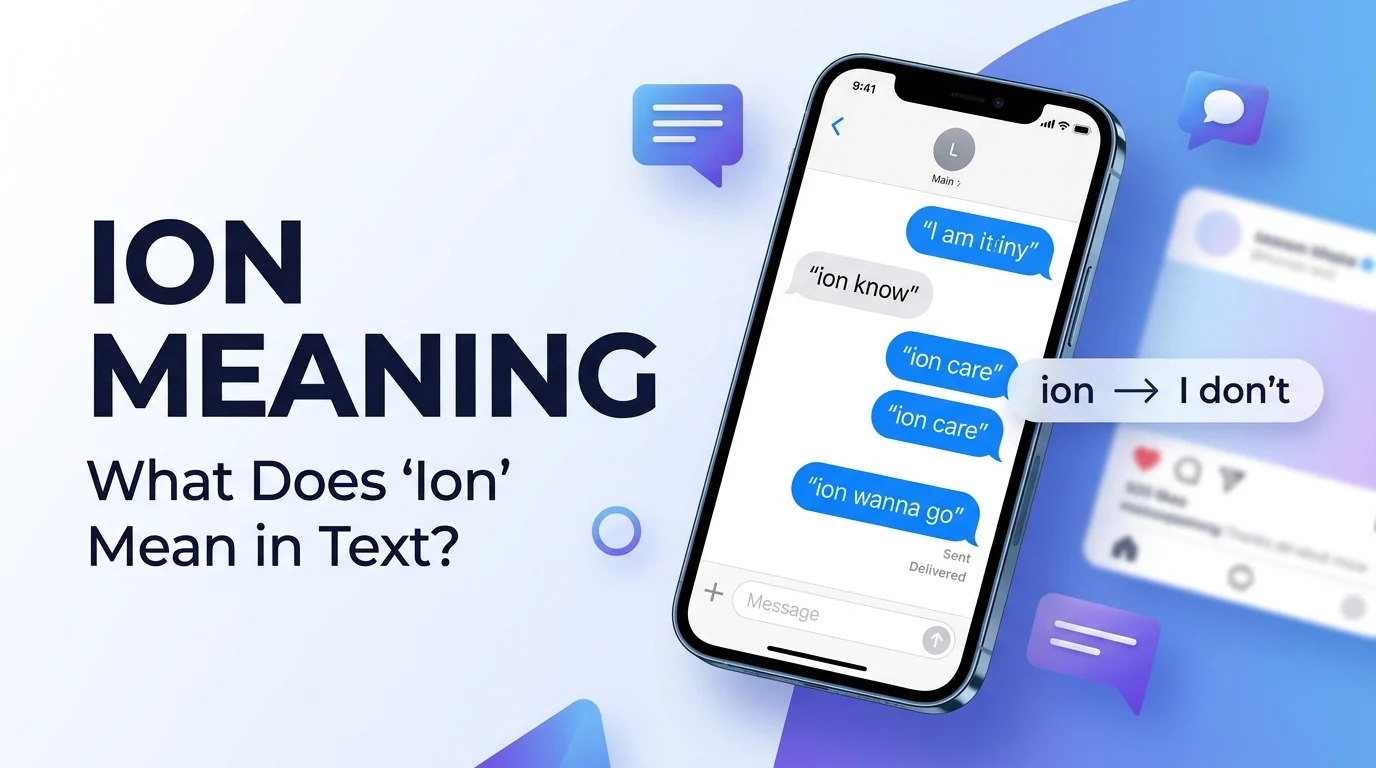

You may see someone text “ion know,” “ion care,” or “ion wanna go” and wonder whether “ion” is an acronym or a typo. In casual texting, ion meaning is usually “I don’t,” written as a phonetic, informal version of the phrase. It commonly appears before verbs, such as “ion know” or “ion want.” Context still matters because “ion” can have other meanings, including the scientific term for a charged particle and, in some contexts, the abbreviation “In Other News.” Here’s how to recognize the slang meaning, understand its tone, use it naturally, and respond when someone sends it.
What Does Ion Mean?
In texting and online slang, ion usually means “I don’t.” It is an informal phonetic spelling that reflects how “I don’t” can sound when spoken casually. For example, “ion know” means “I don’t know,” while “ion care” means “I don’t care.”
| Detail | Explanation |
|---|---|
| Most common slang meaning | “I don’t” |
| Full form | I don’t |
| Typical tone | Casual, informal, sometimes dismissive |
| Common use | Texting, DMs, social media, group chats |
| Formal or informal | Informal |
The term is normally followed by a verb or phrase that completes the thought. Unlike a fixed acronym, it works as a casual replacement for the words “I don’t.”
For example:
“Ion wanna watch that movie.”
This simply means:
“I don’t want to watch that movie.”
The tone can be completely neutral, playful, or slightly dismissive depending on the rest of the message.
Ion Meaning in Text: How Is It Used?
The simplest way to understand the ion meaning in text is to replace “ion” with “I don’t” and see whether the sentence makes sense.
Common examples include:
- “Ion know.” → “I don’t know.”
- “Ion care.” → “I don’t care.”
- “Ion want that.” → “I don’t want that.”
- “Ion think so.” → “I don’t think so.”
- “Ion like this.” → “I don’t like this.”
- “Ion remember.” → “I don’t remember.”
The spelling is intentionally informal. Someone using “ion” usually isn’t trying to write standard English; they are reproducing a casual style of speech in text.
For instance, if a friend asks, “Are you going to the party?” and you answer, “Ion think so,” you are simply saying that you don’t think you will go.
Does Ion Have Other Meanings?
Yes. The lowercase slang form usually means “I don’t,” but capitalization and context can point to another meaning.
| Meaning | Context | Example |
| “I don’t” | Casual slang and texting | “Ion wanna go.” |
| “In Other News” | Topic changes or transitions | “ION, did you see the new trailer?” |
| Ion | Science or chemistry | “The atom became an ion.” |
The “In Other News” interpretation is much easier to recognize when ION introduces a new topic, particularly when it is followed by punctuation.
The scientific meaning is entirely different. In chemistry and physics, an ion is an atom or molecule with an electrical charge. So the surrounding conversation is essential.
How Context Changes the Meaning of Ion
Context usually makes the intended meaning clear. Look at what comes immediately after “ion,” what people are discussing, and how the word is written.
1. Look at the words after it
“Ion” followed by a verb strongly suggests the slang meaning.
“Ion understand.”
That means “I don’t understand.”
2. Check the conversation topic
If someone is talking about chemistry and writes “ion,” they may literally mean a charged particle.
“A sodium ion has a positive charge.”
That has nothing to do with texting slang.
3. Pay attention to punctuation
A message such as:
“ION, did you watch that game?”
may use ION as “In Other News,” especially if the writer is switching subjects.
By contrast:
“ion wanna watch it”
clearly uses the informal “I don’t” meaning.
4. Consider the relationship and tone
A close friend can write “ion care 😂” jokingly, while the same words from someone in an argument may sound dismissive.
Capitalization alone isn’t a perfect rule, but it can provide an additional clue when combined with wording and context.
Ion on TikTok, Snapchat, Instagram, and Text Messages
The slang meaning generally stays the same across casual social platforms: “I don’t.” The main difference is how informal the surrounding conversation is.
Text Messages
In personal texts, “ion” is commonly used as a casual shortcut.
“Ion know what we should eat.”
The tone is relaxed and conversational.
TikTok
In TikTok comments, captions, or messages, “ion” can appear as part of informal internet language.
“Ion even know what happened 😭”
The expression can sound humorous, exaggerated, or conversational depending on the post.
Snapchat
On Snapchat, people may use “ion” in quick messages with friends.
“Ion wanna leave yet.”
It usually keeps the message short and casual.
Instagram and Other Social Chats
DMs and comments can use the same spelling, particularly when the writer wants their message to sound conversational rather than formal.
There is generally no special Instagram-specific definition that changes “ion” from its usual slang meaning.
Real Conversation Examples
1: Friends
Person A: “You coming with us tonight?”
Person B: “Ion think so, I’m tired.”
Meaning: Person B means, “I don’t think so,” and is casually declining.
2: Group Chat
Person A: “Who started this argument?”
Person B: “Ion know 😭 I just got here.”
Meaning: The person is saying, “I don’t know,” with a playful or casual tone.
3: Social Media
Person A: “Everybody says this is the best song on the album.”
Person B: “Ion agree with that.”
Meaning: The person disagrees and is expressing that opinion informally.
Is Ion Rude?
Ion is not automatically rude. Its tone depends heavily on the words around it and the relationship between the people communicating.
For example:
“Ion know lol”
usually sounds casual and harmless.
But:
“Ion care.”
can sound dismissive because the phrase itself communicates indifference.
Adding an emoji or softening the surrounding words can change the impression:
“Ion care 😂 you do you.”
sounds more playful than:
“Ion care.”
The same principle applies to punctuation. A short message with no explanation can feel more blunt than a longer, friendly response.
Is Ion Flirty?
Ion is not inherently flirty. It simply means “I don’t” in its common slang use.
Someone could use it in a flirtatious conversation, but the flirtation would come from the surrounding message rather than the word itself.
For example:
“Ion usually like people this fast 👀”
could sound flirty because of the context and emoji, not because “ion” has a romantic meaning.
How to Reply to Ion
Your best response depends on what the person actually means after “ion.”
Friendly Replies
If the message is casual, you can answer naturally:
- “Lol fair enough.”
- “I get you.”
- “Okay, that makes sense.”
- “Same honestly.”
Funny Replies
If they are joking or being dramatic:
- “You really said ion 😂”
- “Alright, alright, I hear you.”
- “That’s a strong ‘I don’t’ 😭”
- “Okay then, mystery solved.”
Replies When You Are Confused
If you aren’t sure what they mean, simply ask:
- “Wait, you mean you don’t?”
- “Ion = I don’t, right?”
- “What do you mean by ion here?”
There is nothing wrong with asking for clarification when the sentence could have more than one interpretation.
When to Use Ion
Use “ion” mainly in casual communication where informal language already fits. Friends, personal group chats, social media conversations, and relaxed DMs are the most natural settings.
It works especially well when you want your message to sound conversational:
“Ion feel like going out tonight.”
The important part is knowing your audience. If the people you’re talking to regularly use slang, they are more likely to understand it immediately.
When to Avoid Ion
Clearer wording is usually better in professional or formal communication.
Avoid relying on “ion” in:
- Job applications
- Professional emails
- Academic assignments
- Client communication
- Formal announcements
- Business documents
- Messages to unfamiliar people
That doesn’t mean slang is always inappropriate. The issue is clarity and audience. Writing “I don’t” instead of “ion” removes any possibility that the reader will misunderstand your meaning.
Common Mistakes About Ion
| Common Mistake | Correct Understanding |
| Assuming “ion” always means “I don’t” | Context can also indicate the scientific word or “In Other News.” |
| Treating “ion” as a standard formal abbreviation | The “I don’t” form is informal slang. |
| Assuming “ion” always sounds rude | Tone depends on wording, punctuation, relationship, and context. |
| Thinking “ion” means only “I don’t know” | It can replace “I don’t” before many different verbs. |
One particularly common mistake is treating “ion” as a synonym for “I don’t know.” That isn’t quite right. “Ion know” means “I don’t know,” but “ion care” means “I don’t care,” and “ion want” means “I don’t want.”
Similar Slang Terms
Several texting expressions may appear alongside “ion,” but they do different jobs.
| Term | Meaning | Main Difference |
| IDK | I don’t know | Specifically expresses uncertainty or lack of knowledge |
| IDC | I don’t care | Specifically expresses indifference |
| IDT | I don’t think | Expresses an opinion or uncertainty |
| IMO | In my opinion | Introduces a personal viewpoint rather than negation |
| Nah | No or not really | A general informal refusal or negative response |
The key difference is that ion can replace “I don’t” before many different verbs. The other abbreviations generally have more specific meanings.
Where Did Ion Come From?
The slang use of “ion” is a phonetic reduction of “I don’t.” It is associated with African American Vernacular English and has also appeared extensively in informal online communication.
The exact history of the form is difficult to reduce to one specific creator or date, so claims about a single person inventing it or one precise starting year should be treated cautiously.
The important point for everyday readers is that “ion” is not simply a random misspelling. It represents an informal way of writing a spoken pronunciation of “I don’t.”
Quick Recap
- Ion usually means “I don’t” in casual texting and online slang.
- “Ion know” means “I don’t know,” while “ion care” means “I don’t care.”
- The scientific word ion refers to a charged atom or molecule.
- ION can sometimes mean “In Other News” when it introduces a topic change.
- Tone depends on the sentence, punctuation, emojis, relationship, and overall conversation.
- Use the slang form mainly in casual communication rather than formal or professional writing.
Frequently Asked Questions
What does ion mean in text?
In casual texting, “ion” usually means “I don’t” and appears before verbs such as know, want, care, or think.
Is ion rude?
Ion is not inherently rude, although phrases like “ion care” can sound dismissive depending on the conversation and tone.
What does ion mean on TikTok?
On TikTok, ion commonly means “I don’t” and is used as informal slang in comments, captions, and messages.
How should you reply to ion?
Replace “ion” with “I don’t” to understand the sentence, then respond according to the person’s actual statement.
Can ion have different meanings?
Yes, ion can mean “I don’t,” “In Other News,” or a charged particle depending on context and capitalization.
Final Thoughts
The main ion meaning in texting and casual online slang is “I don’t.” It is an informal, phonetic way to write the phrase, as in “ion know,” “ion care,” or “ion wanna go.” While that is the meaning you will usually encounter in casual chat, context still matters because “ion” can also refer to a charged particle or, less commonly, “In Other News.” Pay attention to the surrounding words, capitalization, punctuation, and conversation topic. When used with the right audience, “ion” is simply a casual way to make a message sound more conversational.