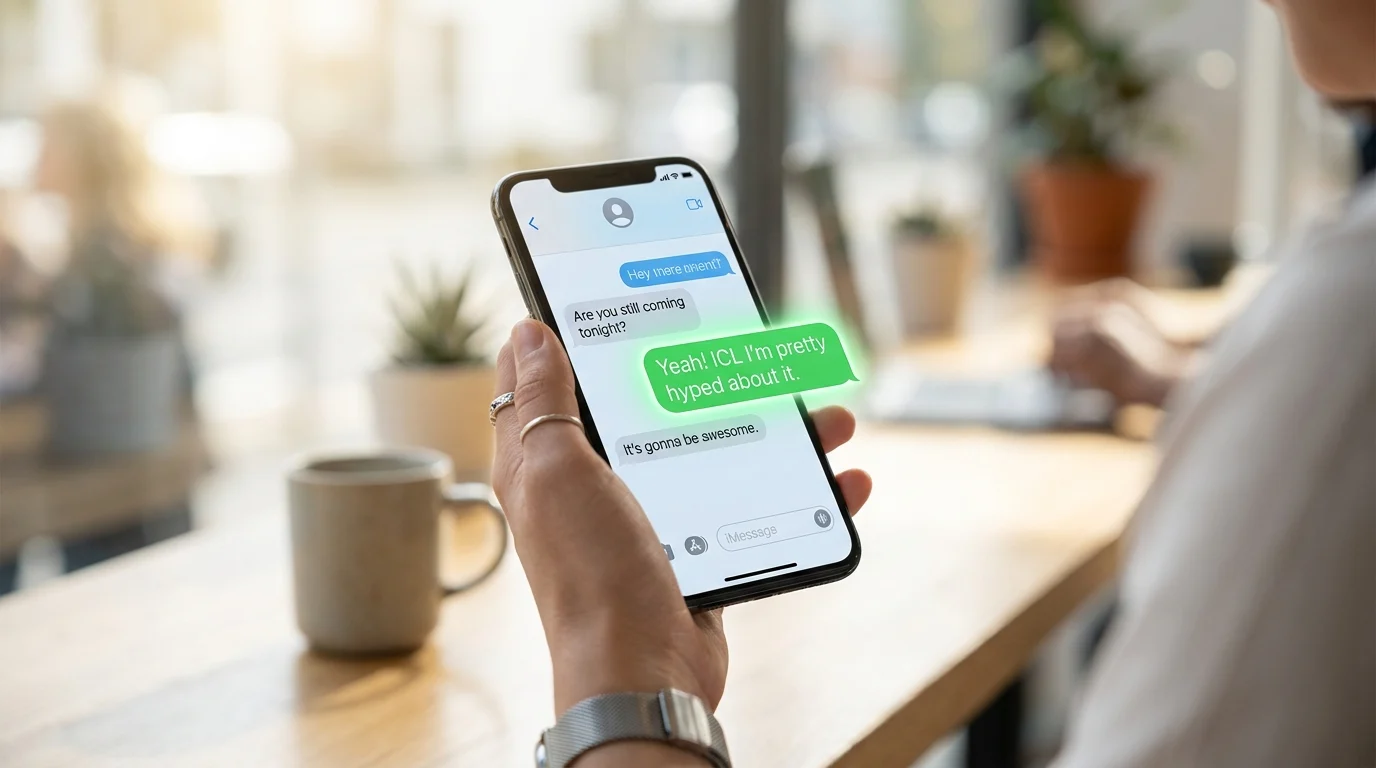

ICL stands for “I Can’t Lie.” It is an internet slang acronym used in texting and social media to introduce an honest opinion, confession, or candid statement. Similar to “TBH” (To Be Honest) and “NGL” (Not Gonna Lie), ICL signals sincerity and emphasizes that the speaker is being truthful about what they are about to say. People use ICL to make conversations feel more genuine, authentic, and straight to the point.
You are scrolling through your Snapchat feed or reading a TikTok comment section, and suddenly you see it: “ICL.” Three little letters that stop you in your tracks. What does it mean? Is it something you should be using? Are you missing out on an inside joke?
Welcome to the ever-evolving world of internet slang. Every year, new abbreviations pop up, spread like wildfire across social media platforms, and become essential pieces of digital vocabulary. ICL is one of those terms. It has quietly slipped into everyday online conversations, and if you do not know what it means, you might find yourself confused in group chats, DMs, and comment sections.
In this guide, we will break down everything you need to know about ICL. You will learn its core meaning, how to use it properly, where it shows up most often, and why it matters in today’s digital culture. By the end, you will be able to recognize, understand, and even use ICL like a pro.
Quick Answer
| Question | Answer |
|---|---|
| Meaning | I Can’t Lie |
| Context | Texting, social media, casual digital conversations |
| Usage | Prefaces an honest opinion, confession, or candid statement |
| Platforms | Snapchat, TikTok, Instagram, WhatsApp, Twitter, text messages |
| Example | “ICL, that movie was actually really good.” |
| Tone | Casual, sincere, sometimes humorous or blunt |
What Does ICL Mean?
ICL is an abbreviation for the phrase “I can’t lie.” It is a modern internet slang term used to emphasize that the person speaking is about to share something honest, sincere, or unfiltered. When someone types “ICL” before a statement, they are essentially saying, “To be honest,” “Truthfully,” or “Let me be real with you for a second.”
Think of ICL as a verbal signal. It sets the tone for whatever comes next. It tells the reader: “What I am about to say is genuine. I am not sugarcoating this. I am keeping it 100% real.” This makes ICL particularly useful in digital communication, where tone and intent can often get lost in translation.
The term is widely used among younger generations, especially Gen Z, who value authenticity in an online world that often feels curated and performative. ICL cuts through the fluff and gets straight to the point.
Core Definition
| Acronym | Full Phrase | Meaning |
|---|---|---|
| ICL | I Can’t Lie | Used to introduce an honest opinion or confession |
Full Definition of ICL
While the surface-level meaning of ICL is straightforward, the term carries some nuance that is worth exploring.
ICL is a discourse marker. In linguistics, a discourse marker is a word or phrase that helps organize conversation, signal relationships between ideas, or indicate the speaker’s attitude toward what they are saying. ICL functions as a discourse marker that signals sincerity, honesty, and authenticity.
When you use ICL, you are doing several things at once:
- Prefacing honesty: You are telling the listener that you are about to be truthful, even if that truth might be uncomfortable, blunt, or surprising.
- Building trust: By declaring your honesty upfront, you are inviting the listener to take your words seriously.
- Adding emphasis: ICL adds weight to your statement. It is not just an opinion; it is an honest opinion.
- Creating intimacy: Sharing honest thoughts often brings people closer. ICL can signal that you are speaking from the heart.
In many ways, ICL is the digital equivalent of leaning in and saying, “Let me be real with you.” It is a tool for cutting through social niceties and getting to the truth.
ICL vs. Similar Slang Terms
ICL is often compared to other honesty-related slang terms. While they share similar functions, there are subtle differences:
- ICL (I Can’t Lie): Emphasizes sincerity and truthfulness. Often used before a personal confession or strong opinion.
- TBH (To Be Honest): A more direct and neutral way to introduce honesty. Can be used in both friendly and blunt contexts.
- NGL (Not Gonna Lie): Similar to ICL but slightly more casual and often used before admitting something slightly embarrassing or unexpected.
- No Cap: Means “no lie” or “for real.” Used to emphasize that a statement is true.
Among these, ICL is often seen as carrying slightly more emphasis than NGL or TBH.
Context and Usage of ICL
Understanding what ICL means is one thing. Knowing when and how to use it is another. This section explores the different contexts where ICL fits naturally.
When to Use ICL
Sharing Honest Opinions
The most common use of ICL is to introduce a genuine opinion. Whether you are talking about a movie, a song, a outfit, or a life decision, ICL signals that your opinion is unfiltered and sincere.
Example: “ICL, that new restaurant is overrated.”
Making Confessions
ICL is often used before admitting something personal. It softens the confession by framing it as honest and vulnerable.
Example: “ICL, I actually cried watching that movie.”
Giving Compliments
When you want someone to know that your compliment is genuine, ICL can add weight to your words.
Example: “ICL, you look amazing in that dress.”
Reacting to Content
On social media, ICL is frequently used in comments and captions to react to videos, photos, or memes.
Example: “ICL, this is the funniest thing I have seen all week.”
Expressing Blunt or Unpopular Opinions
Sometimes, you need to say something that might not be popular. ICL prepares the listener for honesty that might be unexpected.
Example: “ICL, I do not get the hype around that artist.”
When NOT to Use ICL
While ICL is versatile, there are situations where it might not be appropriate:
- Professional Settings: Avoid using ICL in work emails, formal communications, or professional contexts. It is strictly casual slang.
- Serious or Sensitive Conversations: If someone is sharing something deeply personal or emotional, using ICL might come across as flippant or dismissive.
- With People Who Do Not Understand Slang: Not everyone is familiar with internet abbreviations. Using ICL with older generations or non-native speakers might cause confusion.
- Overuse: Using ICL too often can make it lose its impact. Save it for moments when you genuinely want to emphasize honesty.
How to Respond to ICL
When someone uses ICL in a conversation, the appropriate response depends on the context:
- Acknowledge the honesty: “Thanks for being real.”
- Agree or disagree: “ICL, I actually agree with you.”
- Share your own honest opinion: “ICL, I feel the same way.”
- Keep the conversation going: “That is wild, ICL.”
Real-Life Examples of ICL in Conversations
Seeing ICL in action is the best way to understand how it works. Here are five realistic conversation examples across different scenarios.
1: Casual Group Chat
Alex: “Yo, what did everyone think of that new Marvel movie?”
Jordan: “ICL, I was kinda bored. It dragged in the middle.”
Taylor: “ICL, I loved it. Best one since Endgame.”
Alex: “ICL, I am somewhere in between. It had good moments but too long.”
2: Giving a Compliment
Maya: “I am so nervous about this presentation.”
Chris: “You are going to crush it. ICL, you are literally the best public speaker I know.”
Maya: “ICL, that actually made me feel better. Thank you.”
3: Honest Reaction on Social Media
Comment on a viral video: “ICL, this is the most chaotic thing I have seen today and I am here for it.”
Reply: “ICL, same. I cannot stop laughing.”
4: Confession Between Friends
Sam: “I have been thinking about quitting my job.”
Riley: “Wait, really?”
Sam: “ICL, I have been miserable for months. I just needed to say it out loud.”
Riley: “ICL, I am proud of you for being honest about that.”
5: Blunt Opinion
Dana: “Everyone is saying that show is amazing. Have you seen it?”
Eli: “ICL, I tried and could not get past the first episode. It is not for me.”
Dana: “ICL, I actually agree. I thought I was the only one.”
Platform-Specific Meaning of ICL
ICL appears across multiple social media platforms and messaging apps. While the core meaning remains the same, the context and usage can vary slightly depending on where you encounter it.
ICL on Snapchat
On Snapchat, ICL is extremely common in direct messages and snap captions. Users frequently add it to photos or videos to express genuine reactions or opinions. For example, someone might send a snap of their pet with the caption “ICL, he is the cutest dog ever.” Alternatively, if a friend sends a snap asking for an opinion on their outfit, you might reply “ICL, it looks amazing on you.”
Snapchat’s ephemeral nature makes ICL particularly fitting. The platform is built around quick, authentic moments, and ICL helps users convey sincerity in a space that often feels casual and fleeting.
ICL on TikTok
TikTok is where much of today’s internet slang is born and popularized. ICL has a strong presence on the platform, appearing in video captions, comments, and even as part of spoken audio in videos. Users often pair ICL with other viral phrases for comedic effect.
One notable trend involved the phrase “TS PMO ICL,” which stands for “This Shit Pisses Me Off, I Can’t Lie.” This combination of abbreviations became a meme and copypasta, showcasing how ICL can be embedded into larger slang trends.
ICL on Instagram
On Instagram, ICL is used in captions, stories, and comments. It adds a layer of authenticity to posts, which aligns with the platform’s shift toward more “real” and less curated content. You might see a photo of a messy room captioned “ICL, my life is chaos right now” or a comment on a friend’s post saying “ICL, this is your best photo yet.”
ICL on WhatsApp
In WhatsApp group chats and private messages, ICL helps users express feelings quickly without typing out full sentences. It is especially common in teen texting culture and among close friends. For example: “ICL, I did not like the party last night.” The abbreviation allows users to convey tone and emotion efficiently in fast-paced conversations.
ICL on Twitter / X
On Twitter, brevity is key. ICL fits perfectly into the platform’s character limit, allowing users to pack honest opinions into short tweets. You might see tweets like “ICL, this album is underrated” or “ICL, we need to talk about how good this show is.”
ICL in Text Messages
In standard SMS or iMessage conversations, ICL works the same way as on social media. It is a quick way to add sincerity to a statement without typing extra words.
Alternative Meanings of ICL
While “I Can’t Lie” is the most common meaning, ICL can stand for other things depending on the context. It is important to be aware of these alternative meanings to avoid misunderstandings.
Medical Context: Intraocular Collamer Lens
In the medical field, ICL stands for Intraocular Collamer Lens. This is a type of implantable contact lens used in eye surgery to correct vision. If you are reading about vision correction or eye health, ICL almost certainly refers to this medical device rather than the slang term.
Other Technical and Professional Meanings
ICL can also stand for:
- Indian Cricket League: A professional cricket league in India.
- Icon Library: A file extension used for icon collections.
- International Computers Limited: A former British computer company.
- Input Command Language: A computing term.
In most casual online conversations, however, ICL means “I Can’t Lie.” The context usually makes the intended meaning clear.
Regional Variations
In the UK, ICL might carry localized meanings or be adapted for humor and irony in ways similar to US usage. Recognizing regional variations ensures you understand the intended tone when chatting with international friends online.
Related Terms and NLP Variations
ICL is part of a larger ecosystem of internet slang and abbreviations. Understanding these related terms helps you navigate digital conversations more effectively.
Slang Synonyms
- TBH (To Be Honest): A widely used abbreviation for introducing honest statements.
- NGL (Not Gonna Lie): Very similar to ICL, often used interchangeably.
- No Cap: Means “no lie” or “for real.” Used to emphasize truthfulness.
- FR (For Real): Used to express agreement or emphasize sincerity.
- Deadass: A slang term meaning “seriously” or “for real,” popular in certain regions.
Expanded Variations
- ICRL (I Can’t Really Lie): A slight variation that indicates more subdued honesty.
- ICEL (I Can’t Even Lie): Another variation with similar meaning.
How ICL Relates to Other Slang
ICL, TBH, NGL, and No Cap all serve similar functions in digital communication. They are all tools for signaling honesty and authenticity. However, they each have slightly different connotations:
- ICL: Emphasizes sincerity and truthfulness. Sometimes used for blunt or surprising statements.
- TBH: More neutral and direct. Can be used in a wider range of contexts.
- NGL: Often used before admitting something slightly embarrassing or unexpected.
- No Cap: Emphasizes that a statement is genuinely true, often used for emphasis.
How to Respond to ICL
When someone uses ICL in a conversation, your response can vary depending on the context and your relationship with the person. Here are some strategies for responding effectively.
Acknowledge the Honesty
If someone shares an honest opinion using ICL, acknowledging their sincerity can strengthen the connection.
- “Thanks for being real about that.”
- “I appreciate your honesty.”
- “ICL, I am glad you said that.”
Agree or Disagree
You can respond with your own honest opinion, using ICL or a similar term.
- “ICL, I actually agree with you.”
- “ICL, I see it differently, but I get your point.”
- “NGL, I feel the same way.”
Ask Follow-Up Questions
If the ICL statement opens up a deeper topic, asking questions can keep the conversation going.
- “What made you feel that way?”
- “ICL, I have been thinking about that too. What do you mean exactly?”
Use Humor
ICL is often used in lighthearted or humorous contexts. Responding with a joke or playful comment can keep the vibe casual.
- “ICL, you are wild for that take.”
- “ICL, I cannot believe you just said that.”
Misinterpretations and Common Mistakes
Like any slang term, ICL can be misunderstood or used incorrectly. Here are some common pitfalls to avoid.
Confusing ICL with Other Abbreviations
Because ICL looks similar to other acronyms, it is easy to mix them up. The most common confusion is with ICL versus IRL (In Real Life). While ICL means “I Can’t Lie,” IRL means “In Real Life.” Mixing these up can lead to confusing messages.
Using ICL in the Wrong Context
As mentioned earlier, ICL is casual slang. Using it in professional or formal settings can come across as unprofessional or immature. Save ICL for texts, DMs, and social media with friends and peers.
Overusing ICL
If you use ICL in every other sentence, it loses its impact. The term is most effective when used sparingly, in moments where you genuinely want to emphasize honesty.
Assuming Everyone Knows What ICL Means
Not everyone is up to date on internet slang. If you are texting someone who might not understand ICL, consider spelling out “I can’t lie” instead. This avoids confusion and ensures your message is understood.
Using ICL for Sarcasm Without Clear Context
ICL can be used sarcastically, but this requires clear context. If you use ICL ironically and the other person does not realize it, they might take your statement at face value. When in doubt, add an emoji or other context clue to signal sarcasm.
When NOT to Use ICL
While ICL is a useful and versatile slang term, there are times when it is better to avoid it.
Professional and Formal Communication
ICL has no place in work emails, business proposals, academic writing, or formal correspondence. In these contexts, use full phrases like “to be honest” or “truthfully” if you need to emphasize sincerity.
Serious or Sensitive Topics
If someone is sharing something deeply personal, emotional, or traumatic, using ICL might come across as dismissive or flippant. In these situations, prioritize empathy and active listening over casual slang.
With People Who Do Not Understand Slang
Older generations, non-native English speakers, and people who are not active on social media may not know what ICL means. Using it with them can create confusion and miscommunication.
When You Do Not Actually Mean It
ICL is meant to signal genuine honesty. Using it when you are not actually being honest undermines its purpose and can damage trust.
Usage Tips for ICL
Here are some practical tips for using ICL effectively and naturally.
Start or End Your Sentence with ICL
ICL can be placed at the beginning or the end of a sentence. Both positions work well, though starting with ICL is more common.
- Beginning: “ICL, that pizza was incredible.”
- End: “That pizza was incredible, ICL.”
Pair ICL with Other Slang for Emphasis
ICL pairs naturally with other slang terms to add emphasis or humor.
- “ICL, that was lowkey the best concert ever.”
- “ICL, no cap, that was .”
- “ICL, fr, I cannot believe that happened.”
Use ICL to Soften Blunt Statements
If you need to say something that might be perceived as harsh or overly critical, ICL can soften the blow by framing it as honest rather than mean.
- Instead of: “That outfit is ugly.”
- Try: “ICL, that outfit is not my favorite.”
Match Your Tone to the Conversation
ICL works best in casual, friendly conversations. Pay attention to the tone of the conversation and use ICL when it feels natural and appropriate.
Frequently Asked Questions About ICL
Q1: What does ICL mean in texting?
In texting, ICL stands for “I Can’t Lie.” It is used to introduce an honest opinion or confession.
Q2: What does ICL mean on Snapchat?
On Snapchat, ICL means “I Can’t Lie.” It is commonly used in snaps and direct messages to express sincerity.
Q3: Is ICL the same as NGL?
ICL and NGL are very similar, but ICL often carries slightly more emphasis on sincerity and truthfulness. NGL (Not Gonna Lie) is often used before admitting something unexpected or slightly embarrassing.
Q4: What does ICL mean on TikTok?
On TikTok, ICL means “I Can’t Lie.” It appears in captions, comments, and videos to preface honest or candid statements.
Q5: What does ICL mean in the UK?
In the UK, ICL generally means the same thing: “I Can’t Lie.” Regional usage may involve slight variations in tone or humor.
Q6: What does ICL stand for in medical terms?
In medicine, ICL stands for Intraocular Collamer Lens, a type of implantable contact lens used in vision correction surgery.
Q7: What does “TS PMO ICL” mean?
“TS PMO ICL” stands for “This Shit Pisses Me Off, I Can’t Lie.” It is a slang combination that gained popularity on TikTok.
Q8: Is ICL safe for work?
ICL is generally safe for work in the sense that it is not offensive, but it is casual slang and should be avoided in professional settings.
Q9: Can ICL be used sarcastically?
Yes, ICL can be used sarcastically, but context is important to avoid confusion. Adding an emoji or using an exaggerated tone can help signal sarcasm.
Q10: Who uses ICL the most?
ICL is most commonly used by Gen Z and younger millennials who are active on social media platforms like TikTok, Snapchat, and Instagram.
Q11: How do you respond to ICL?
You can respond by acknowledging the honesty, agreeing or disagreeing, asking follow-up questions, or using humor. For example, “ICL, I actually agree with you.”
Q12: What is the difference between ICL and TBH?
ICL emphasizes sincerity and truthfulness, often before a personal confession or strong opinion. TBH (To Be Honest) is more neutral and direct, usable in a wider range of contexts.
Q13: Can I use ICL in a professional email?
No, ICL is casual slang and should not be used in professional emails or formal communications.
Q14: What does ICRL mean?
ICRL stands for “I Can’t Really Lie,” a slight variation of ICL that indicates more subdued honesty.
Q15: Is ICL outdated?
No, ICL remains widely used in 2025 and continues to be a popular slang term across social media platforms.
Conclusion
ICL is more than just three letters. It is a tool for connection, a signal of sincerity, and a marker of authenticity in a digital world that often feels curated and performative. Whether you are texting friends, commenting on TikTok, or sending a Snap, ICL helps you say, “I am being real with you.”
The term emerged from the creative cauldron of internet culture and has found a permanent home in the vocabulary of Gen Z and beyond. It works alongside other honesty markers like TBH, NGL, and No Cap to create conversations that feel genuine, unfiltered, and human.
Understanding ICL is not just about knowing what it stands for. It is about understanding how digital communication evolves and how we use language to build trust and connection in online spaces. The next time you see ICL in a message, you will know exactly what it means. And if you want to keep it real yourself, you now know how to use it.
So go ahead. ICL to share an honest opinion. Use it to give a genuine compliment. Use it to confess something you have been holding back. Just remember to keep it authentic. That is what ICL is all about.