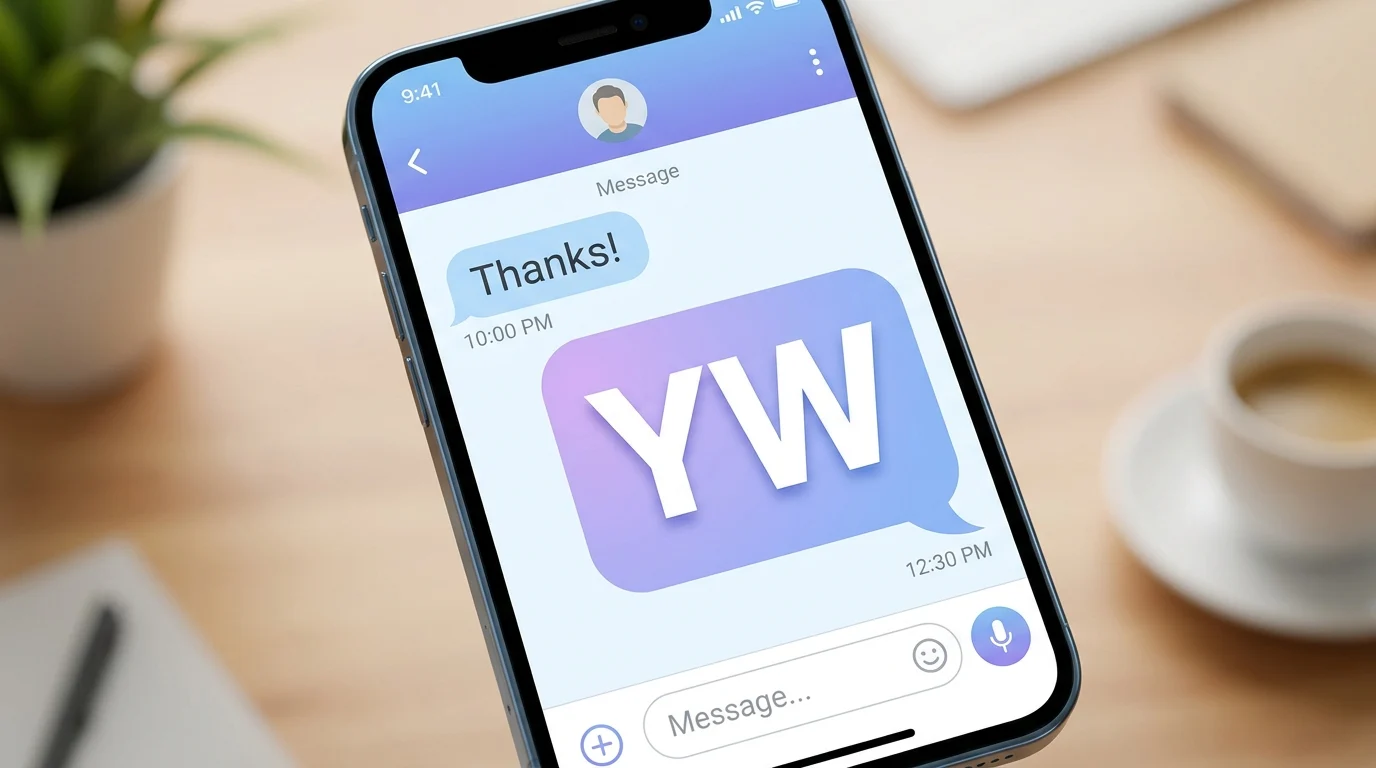

You thank someone over text, and they reply with “YW.” If you are unsure what those two letters mean, the yw meaning is usually “you’re welcome.” It is a short, casual way to acknowledge someone’s thanks without typing the full phrase. You will most often see YW in text messages, chats, social media conversations, and other informal exchanges. The meaning is generally straightforward, but the tone can change depending on the conversation, punctuation, and relationship between the people involved. Understanding those small differences can help you tell whether YW sounds friendly, neutral, playful, or slightly dismissive.
What Does YW Mean?
YW most commonly stands for “you’re welcome.” People use it after someone says “thanks” or “thank you,” especially in casual digital conversations. It is an abbreviation rather than a separate slang expression, so its meaning normally stays consistent across texting and social media.
| Detail | Explanation |
|---|---|
| Most Common Meaning | You’re welcome |
| Full Form | You’re welcome |
| Tone | Casual, friendly, or neutral |
| Common Platforms | Text, messaging apps, social media, chats |
| Formal or Informal | Informal |
For example:
Person A: “Thanks for sending me the notes!”
Person B: “YW!”
Here, YW simply means “you’re welcome” and signals that Person B is acknowledging the thanks.
YW Meaning in Text and Chat
When someone sends YW in text, the intended meaning is almost always “you’re welcome.” It commonly appears immediately after a thank-you message.
You might see exchanges such as:
“Thanks for helping me with that.”
“YW!”
Or:
“Thank you!!”
“yw 😊”
The abbreviation saves time and keeps the conversation informal. Because it is so short, the surrounding conversation can affect how it feels.
A lowercase “yw” may look especially casual, while “YW!” can feel more enthusiastic. A simple “YW” without punctuation is usually neutral, although some people may interpret very short replies as less warm than a full “you’re welcome.”
Is YW Always “You’re Welcome”?
In ordinary texting, “you’re welcome” is by far the standard interpretation of YW. Unlike some abbreviations that have several widely recognized slang definitions, YW generally does not require complicated decoding when it appears after “thanks.”
Context still matters, particularly if YW appears without a preceding thank-you message. If the conversation does not involve gratitude, you should avoid automatically assuming what the abbreviation means.
The safest approach is to look at the messages immediately before it. If someone says “thanks,” “thank you,” or “appreciate it,” YW almost certainly means “you’re welcome.”
How Context Changes the Tone of YW
The basic meaning stays the same, but the emotional tone can vary.
1. Friendly
“Thanks for grabbing that for me!”
“YW 😊”
The emoji makes the response feel warm and friendly.
2. Neutral
“Thanks for the information.”
“YW.”
This is a straightforward acknowledgment without much emotional emphasis.
3. Playful
“Thank you for saving me from that terrible presentation 😂”
“YW 😂”
The surrounding humor makes the abbreviation feel playful.
4. Potentially Dismissive
“Thanks.”
“yw”
If the conversation is already tense, an extremely brief response could feel cold or dismissive. However, the abbreviation itself is not inherently rude. The relationship, previous messages, punctuation, and overall tone matter more.
YW on Different Platforms
The meaning of YW generally does not change significantly from one major messaging platform to another.
Text Messages and WhatsApp
YW commonly means “you’re welcome” after someone expresses thanks.
Example:
“Thanks for picking me up.”
“YW!”
The tone is casual and efficient.
Instagram and Snapchat
The same meaning is common in DMs and informal conversations.
Example:
“Thanks for the recommendation!”
“yw :)”
The lowercase form and smiley can make the response feel relaxed.
TikTok
If YW appears in a comment or direct message following a thank-you, it generally carries the same “you’re welcome” meaning.
Example:
“Thanks for explaining this!”
“YW!”
There is no special TikTok-specific definition required to understand it in this context.
Group Chats and Online Communities
YW can be used when one person thanks another for information, help, a file, or an explanation.
Example:
“Thanks for sending the schedule!”
“YW everyone.”
The basic purpose remains the same: acknowledging gratitude.
YW Conversation Examples
1: Friends
Person A: “Thanks for bringing my charger!”
Person B: “YW, I knew you’d forget it.”
Meaning: Person B is saying “you’re welcome” while adding a playful comment about their friend.
2: Classmates
Person A: “Thank you for sending me the homework instructions.”
Person B: “YW!”
Meaning: The response is polite but informal and acknowledges the classmate’s thanks.
3: Social Media
Person A: “Thanks for explaining how you made this!”
Person B: “yw 😊”
Meaning: The person is responding warmly and casually to the compliment or thanks.
Is YW Rude?
YW is not inherently rude. It is a normal informal abbreviation for “you’re welcome.”
However, a very short reply can sometimes seem less enthusiastic than a full response. For example, “YW!!” may feel more energetic than “yw,” while “You’re welcome!” sounds clearer and warmer in many situations.
If someone is thanking you sincerely for something meaningful, consider the relationship and situation before choosing the shortest possible response.
Is YW Flirty?
YW is not normally a flirty abbreviation. Its basic purpose is simply to respond to someone’s thanks.
That said, the surrounding conversation can create a flirty tone. An exchange such as “Thanks, you’re sweet” followed by “YW 😉” may feel playful or suggestive because of the wording and emoji, not because YW itself has a romantic meaning.
You should therefore avoid interpreting YW alone as a sign of flirting.
How to Reply to YW
Because YW already means “you’re welcome,” you usually do not need to send another response. If you want to continue the conversation, however, your reply can match the situation.
Friendly Replies
- “Of course!”
- “Anytime!”
- “No problem!”
- “Appreciate you!”
- “Thanks again!”
Funny Replies
- “I accept payment in snacks 😂”
- “You owe me one!”
- “Anything for you 😂”
- “My heroic work is done.”
Replies When You Want to Continue Talking
- “Of course! How’s everything going?”
- “No problem! Did you get everything you needed?”
- “Anytime. What are you up to now?”
If the exchange is already finished, leaving YW without another response is perfectly normal.
When to Use YW
YW works best in casual communication where abbreviations are expected. You can use it with friends, classmates, relatives you regularly text, online acquaintances, and familiar group chats.
It is especially useful when the conversation is moving quickly and everyone understands common texting abbreviations.
For example, replying “YW!” after a friend says “thanks” feels natural and efficient. The abbreviation also works well when you want to keep a simple interaction from becoming unnecessarily formal.
When to Avoid YW
YW is less suitable when you need a professional or highly polished tone. In a business email, academic message, formal announcement, or client conversation, writing “you’re welcome” is usually clearer.
That does not mean abbreviations are always inappropriate at work. If your workplace has an established casual messaging style, YW may be understood easily. Still, when you are communicating with someone unfamiliar or in a sensitive situation, spelling out the phrase avoids unnecessary ambiguity.
Common Mistakes About YW
| Common Mistake | Correct Understanding |
| Assuming YW is always rude | It is generally a neutral, casual abbreviation. |
| Thinking YW is automatically flirty | YW itself simply means “you’re welcome.” |
| Ignoring the previous message | A preceding “thanks” strongly clarifies the intended meaning. |
Another common mistake is assuming capitalization changes the definition. In most casual conversations, YW, yw, and Yw mean the same thing; formatting mainly affects appearance and sometimes perceived tone.
Similar Slang and Text Abbreviations
YW can be confused with other short responses used after someone expresses gratitude.
| Term | Meaning | Main Difference |
| YW | You’re welcome | Direct response to thanks |
| NP | No problem | Reassures the person that helping was not an issue |
| NBD | No big deal | Minimizes the importance of what happened |
| TY | Thank you | Expresses gratitude rather than responding to it |
| THX | Thanks | Casual shortened form of “thanks” |
These terms can overlap in conversation, but they are not interchangeable in every sentence. YW specifically functions as a response to gratitude.
Origin and Popularity of YW
YW is a straightforward shortening of “you’re welcome” used in informal digital communication. There is no need to attach a specific creator or exact invention date to it.
Like many texting abbreviations, its appeal comes from brevity: two letters can communicate the same basic response as a longer phrase. The important point for readers is the established usage rather than an uncertain origin story.
Quick Recap
- YW most commonly means “you’re welcome.”
- It is usually used after someone says “thanks” or “thank you.”
- The abbreviation is casual rather than formal.
- YW itself is not inherently rude or flirty.
- Emojis, punctuation, wording, and the relationship between speakers can change how the response feels.
- If you need a more professional tone, spell out “you’re welcome.”
Frequently Asked Questions
What does YW mean in text?
YW usually means “you’re welcome” and commonly appears as a casual response after someone says thanks.
Is YW rude?
YW is generally not rude, although an extremely brief reply can seem less warm in certain conversations.
What does YW mean on TikTok?
On TikTok, YW usually means “you’re welcome” when someone responds to another person’s thanks.
How should you reply to YW?
You can leave it there or continue naturally with “of course,” “anytime,” or another conversational response.
Can YW have different meanings?
YW can have other interpretations in specialized contexts, but “you’re welcome” is the standard meaning in casual chat.
Final Thoughts
The yw meaning is usually simple: “you’re welcome.” You will most often see it in texts, DMs, group chats, and social media conversations after someone expresses thanks. Although the abbreviation itself is neutral and casual, the surrounding conversation can influence whether it feels warm, playful, or slightly distant. Pay attention to capitalization, punctuation, emojis, and your relationship with the other person rather than judging the abbreviation on its own. For everyday conversations, YW is a convenient shorthand; for professional or formal communication, spelling out “you’re welcome” is usually the safer choice.