
You may have come across the word proscribed in a legal document, news article, or formal discussion and wondered exactly what it means. The short answer is simple: proscribed means officially forbidden, banned, or prohibited by an authority or law. Because it looks very similar to prescribed, many people confuse the two words even though they have nearly opposite meanings.
Understanding the context is essential. Depending on the sentence, proscribed usually refers to something that has been legally or officially prohibited rather than merely discouraged. This guide explains the proscribed meaning, how to use it correctly, common examples, similar words, and the mistakes people often make.
What Does Proscribed Mean?
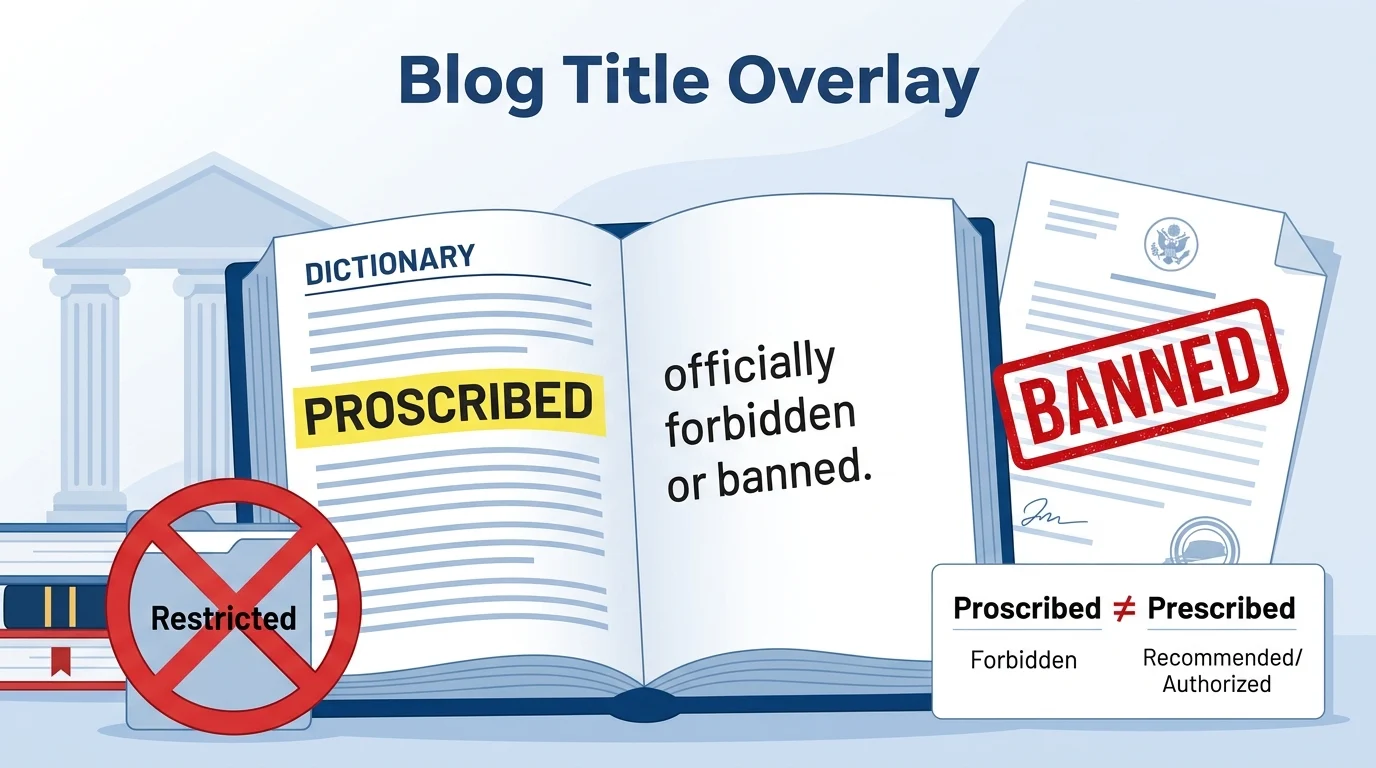
Proscribed means officially forbidden, prohibited, or banned by a law, government, organization, or other authority.
| Detail | Explanation |
|---|---|
| Most Common Meaning | Officially forbidden or banned |
| Full Form | Not an acronym or abbreviation |
| Tone | Formal and legal |
| Common Contexts | Law, government, policy, regulations |
| Formal or Informal | Formal |
Unlike internet slang or texting abbreviations, proscribed is a standard English adjective and past participle most often found in legal, governmental, and academic writing.
The Main Meaning of Proscribed
The primary meaning of proscribed is declared illegal, prohibited, or not allowed by an authority.
When something is proscribed, there is usually an official rule or decision behind the restriction. The authority could be:
- A government
- A court
- A regulatory agency
- An employer
- An educational institution
- An organization
Simple Definition
Proscribed = officially banned or forbidden.
Example
“The organization was proscribed under national security legislation.”
Meaning: The government officially declared that organization illegal or banned its activities.
Another example:
“Certain chemicals are proscribed in food production.”
Here, the sentence means those chemicals are not permitted under applicable regulations.
The word carries a formal tone and rarely appears in everyday conversation.
Alternative Meanings
The core meaning of proscribed remains remarkably consistent across different contexts. However, the authority imposing the prohibition may vary.
| Meaning | Context | Tone | Example |
|---|---|---|---|
| Officially banned | Government and law | Formal | “The group was proscribed.” |
| Forbidden by policy | Workplace or school | Formal | “Proscribed behavior may lead to discipline.” |
| Prohibited by regulation | Professional or technical writing | Formal | “The procedure is proscribed under current guidelines.” |
Unlike many English words, proscribed does not have widely accepted slang, texting, or social media meanings.
How Context Changes the Meaning
Although the basic definition stays the same, the surrounding words help identify who has prohibited something and why.
Consider these examples:
Example 1
“The government proscribed several extremist organizations.”
Here, a government has officially banned specific organizations.
Example 2
“The company’s handbook lists proscribed conduct.”
In this case, the employer has identified behaviors employees are not allowed to engage in.
Example 3
“The medication contains proscribed substances.”
The restriction likely comes from health or regulatory authorities.
Example 4
“Certain actions are proscribed during examinations.”
Here, the prohibition comes from school or testing rules rather than national law.
The surrounding nouns—such as government, company, school, or regulations—make the intended authority clear.
Meaning in Different Contexts
Unlike many modern terms, the meaning of proscribed changes very little across platforms or settings. Instead, the context determines which authority is enforcing the prohibition.
Legal Documents
This is the most common use.
Example:
“The activities are proscribed by federal law.”
The word signals a legally enforceable ban.
News Reporting
Journalists often use proscribed when discussing organizations, sanctions, or regulations.
Example:
“Authorities confirmed the organization remains proscribed.”
The tone is factual and formal.
Workplace Policies
Organizations may describe prohibited conduct as proscribed.
Example:
“Harassment is proscribed under company policy.”
This refers to internal rules rather than criminal law.
Academic Writing
Researchers and scholars sometimes use the word when discussing historical laws, ethics, or regulations.
Example:
“The practice was proscribed during the period.”
The tone remains objective and formal.
Real Conversation Examples
Although uncommon in casual speech, you may hear or read proscribed in professional settings.
Example 1
Person A: “Can employees accept gifts from clients?”
Person B: “No, that’s specifically proscribed by company policy.”
Meaning: Company rules forbid accepting gifts.
Example 2
Person A: “Why was that organization shut down?”
Person B: “It was proscribed by the government.”
Meaning: It was officially banned.
Example 3
Person A: “Can we use this chemical?”
Person B: “No, it’s a proscribed substance.”
Meaning: Regulations prohibit its use.
Tone and Emotional Meaning
The word proscribed is almost always neutral and formal.
It does not express emotion by itself. Instead, it communicates that an official prohibition exists.
Is Proscribed Rude?
No.
The word is not rude or offensive. It simply describes something that has been officially forbidden.
Is Proscribed Formal?
Yes.
You are far more likely to encounter proscribed in:
- Legal documents
- Government statements
- Corporate policies
- Academic writing
- News reports
In everyday conversation, people often choose simpler alternatives such as:
- Banned
- Forbidden
- Illegal
- Not allowed
- Prohibited
These alternatives sound more natural in casual speech.
How to Reply When Someone Uses “Proscribed”
Most situations don’t require a special reply because proscribed is simply descriptive. Instead, respond based on the discussion.
Polite Replies
- “Understood. We’ll follow the policy.”
- “Thanks for clarifying.”
- “I’ll avoid using that.”
- “That makes sense.”
- “We’ll make sure to comply.”
Replies When You’re Confused
- “Do you mean it’s officially banned?”
- “Who proscribed it?”
- “Is that prohibited by law or company policy?”
These responses help clarify the authority behind the restriction.
When to Use the Term
Use proscribed when discussing official prohibitions.
Good situations include:
- Legal writing
- Government announcements
- Compliance documents
- Policy manuals
- Academic papers
- Formal news reporting
Because the word has a precise legal flavor, it works best when an identifiable authority has imposed the restriction.
When to Avoid the Term
Avoid using proscribed when a simpler word communicates your meaning more naturally.
For example, in casual conversation, saying:
“It’s banned.”
is usually clearer than:
“It’s proscribed.”
You should also avoid the word when:
- Writing to audiences unfamiliar with formal legal language
- Sending casual text messages
- Posting on social media unless discussing legal matters
- Giving quick everyday instructions
In those cases, words like forbidden, not allowed, or prohibited are often easier to understand.
Common Mistakes
Many misunderstandings arise because proscribed closely resembles prescribed.
| Common Mistake | Correct Understanding |
|---|---|
| Confusing proscribed with prescribed | Proscribed means forbidden; prescribed means officially recommended or authorized. |
| Assuming it means merely discouraged | It usually indicates an official prohibition. |
| Using it in casual conversation unnecessarily | Simpler words are often clearer for everyday communication. |
The first mistake is especially common because only two letters differ, yet the meanings are nearly opposite.
Similar Terms
| Term | Meaning | Main Difference |
|---|---|---|
| Prohibited | Not allowed | General term for something forbidden. |
| Banned | Officially forbidden | More common in everyday English. |
| Forbidden | Not permitted | Broader and less formal. |
| Illegal | Against the law | Specifically refers to breaking the law. |
| Prescribed | Officially recommended or authorized | Nearly the opposite of proscribed. |
Among these, prescribed causes the greatest confusion because of its similar spelling.
For example:
- Prescribed medication = medication a doctor authorizes.
- Proscribed substance = substance officially forbidden.
Origin and Popularity
The word proscribed comes from the verb proscribe, which has long been used in English to describe the act of officially forbidding or condemning something. Historically, the term has appeared in legal and political contexts, where governments or authorities formally declared individuals, groups, or activities to be prohibited.
While the exact historical development spans many centuries, the modern meaning remains consistent: an official ban or prohibition. Today, it continues to appear primarily in legal, governmental, regulatory, and academic writing rather than everyday conversation.
Quick Recap
- Proscribed means officially forbidden, prohibited, or banned.
- It is a formal English word, not an internet slang term or abbreviation.
- The meaning usually stays the same regardless of context.
- The authority imposing the prohibition may be a government, employer, school, or organization.
- Do not confuse proscribed with prescribed, which has almost the opposite meaning.
Frequently Asked Questions
What does proscribed mean in text?
It means officially forbidden or prohibited, although the word appears far more often in formal writing than casual texting.
What does proscribed mean?
It means something has been officially banned, prohibited, or forbidden by a recognized authority or governing body.
Is proscribed the same as prescribed?
No, proscribed means forbidden, while prescribed means officially recommended, authorized, or directed for use.
How should you reply to someone using proscribed?
Respond according to the discussion or ask whether the prohibition comes from law, policy, or another official authority.
Can proscribed have different meanings?
Its core meaning remains officially forbidden, though the authority enforcing the prohibition varies with the context.
Final Thoughts
The proscribed meaning is straightforward once you separate it from the similar-looking word prescribed. In nearly every context, proscribed means officially forbidden, banned, or prohibited by a recognized authority. Whether you encounter it in legal documents, workplace policies, government announcements, or news reports, the surrounding context usually identifies who imposed the restriction. Using the word correctly helps you communicate with precision, while recognizing when a simpler alternative such as banned or prohibited may better suit everyday conversations.