
You may see “Don’t Tread on Me” on a flag, sticker, shirt, social media profile, or bumper sticker and wonder what the phrase actually means. The dont tread on me meaning is essentially a warning against being controlled, oppressed, interfered with, or having your rights violated. It is strongly associated with the Gadsden flag and ideas of personal liberty, independence, and resistance to government overreach. However, the phrase can carry different political or cultural associations depending on who uses it and where you see it. Understanding the wording, historical background, symbolism, and modern context makes its intended meaning much easier to recognize.
What Does Don’t Tread on Me Mean?
“Don’t Tread on Me” means do not step on, oppress, control, or interfere with me. The phrase expresses a strong demand for personal freedom and independence, often implying that someone will resist attempts to restrict their rights or autonomy.
| Detail | Explanation |
|---|---|
| Most Common Meaning | A warning against oppression, interference, or loss of liberty |
| Symbol | Commonly associated with the Gadsden flag and rattlesnake |
| Tone | Defiant, assertive, independent |
| Common Contexts | Politics, history, protests, social media, personal-expression contexts |
| Formal or Informal | A traditional slogan rather than ordinary conversational slang |
The phrase is not normally an abbreviation or internet slang term, so there is no full form for “Don’t Tread on Me.” It is a complete statement.
What Is the Main Meaning of Don’t Tread on Me?
The core idea is simple: respect my freedom and boundaries, and do not try to dominate me.
The word “tread” literally refers to stepping or walking on something. In the slogan, however, it has a figurative meaning. Someone saying “Don’t Tread on Me” is warning another person not to violate their rights, freedom, independence, or personal boundaries.
The phrase can therefore communicate several closely related ideas:
- Personal independence
- Resistance to oppression
- Defense of individual rights
- Opposition to excessive control
- Strong personal boundaries
- Willingness to resist interference
For example:
“I’ll make my own decisions. Don’t tread on me.”
Here, the speaker is not talking about someone physically stepping on them. They are asserting independence and asking others not to control their choices.
Why Is a Snake Associated With Don’t Tread on Me?
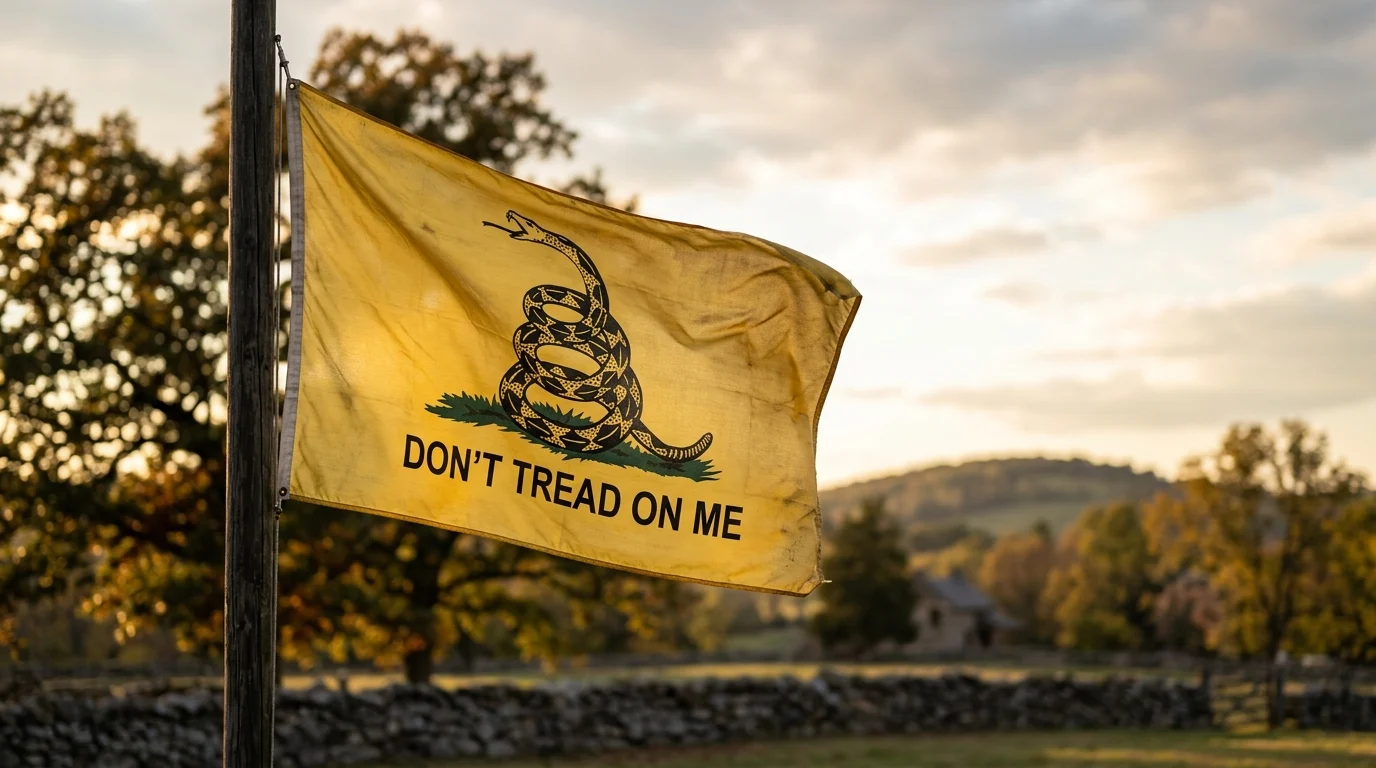
The phrase is closely connected to the Gadsden flag, which features a coiled rattlesnake above or beside the words “Don’t Tread on Me.”
The rattlesnake works as a warning symbol. A coiled snake can appear relatively still, but a rattlesnake is capable of defending itself when threatened. That imagery reinforces the slogan’s message: do not provoke or attack someone who intends to defend themselves.
The symbol became associated with the American Revolutionary era and has continued to be used long after that period. Today, seeing the phrase alongside a yellow flag and rattlesnake is often a clear reference to the Gadsden flag rather than ordinary slang.
Is Don’t Tread on Me a Political Phrase?
It can be, but the exact political meaning depends on the person using it.
Historically, the slogan is associated with American revolutionary ideas about independence and resistance to authority. In modern America, the Gadsden flag and its slogan have also been adopted by people and movements emphasizing individual liberty, limited government, gun rights, anti-government sentiment, or opposition to perceived government overreach.
At the same time, not everyone who uses the phrase intends a specific political message. Someone might use it simply to express independence, personal freedom, or a strong dislike of being controlled.
That distinction matters. The words themselves communicate resistance to interference, while the surrounding setting may reveal whether the speaker intends a political, historical, personal, or cultural message.
How Context Changes the Meaning
The dont tread on me meaning becomes clearer when you consider where and how the phrase appears.
On a flag
A yellow flag with a rattlesnake and “Don’t Tread on Me” usually points to the Gadsden flag and its historical symbolism. In a political setting, it may communicate a stronger message about government authority or individual rights.
In a personal statement
If someone writes, “Don’t tread on me—I know what I want,” the phrase is probably being used as an expression of independence rather than as a reference to a political movement.
In a protest
The slogan may express resistance to a policy, institution, government action, or perceived restriction of rights.
In a humorous post
Someone might use the phrase dramatically or jokingly:
“You touched my fries. Don’t tread on me.”
Here, the speaker is exaggerating the slogan for humor rather than making a serious political statement.
The surrounding words, imagery, punctuation, audience, and subject of the conversation all help establish the intended tone.
Don’t Tread on Me in Text and Social Media
Unlike abbreviations such as “LOL” or “IDK,” “Don’t Tread on Me” does not have a special hidden meaning when used in text messages. Its basic meaning remains a warning against interference or control.
On social media, however, the phrase can communicate more than its literal wording because of its cultural symbolism.
A post saying:
“Don’t tread on me. 🐍”
may emphasize independence, resistance, or personal boundaries.
If the phrase appears with political imagery, protest content, or a Gadsden flag, the intended message is more likely to involve political or ideological ideas.
On platforms such as TikTok, Instagram, Snapchat, Reddit, or X, the phrase does not have a separate universal platform-specific definition. Context remains more important than the platform itself.
Real Conversation Examples
1: Personal independence
Person A: “Why don’t you just let your friends decide what you should do?”
Person B: “No thanks. Don’t tread on me.”
Meaning: Person B is asserting independence and saying they do not want other people controlling their decisions.
2: Political discussion
Person A: “The government shouldn’t have unlimited power over people’s private choices.”
Person B: “Exactly. Don’t tread on me.”
Meaning: Here, the phrase expresses a political belief centered on individual liberty and opposition to excessive government control.
3: Humor
Person A: “I’m taking the last slice of pizza.”
Person B: “Don’t tread on me!”
Meaning: The speaker is jokingly borrowing the serious slogan to playfully defend their share of the pizza.
What Tone Does Don’t Tread on Me Have?
The phrase is generally strong, defiant, and assertive. It is not usually neutral language.
Its tone can vary considerably:
- Defiant: “You won’t control me.”
- Assertive: “Respect my boundaries.”
- Political: “Protect individual liberty from excessive authority.”
- Historical: “I am referencing American Revolutionary symbolism.”
- Humorous: “I’m exaggerating my resistance for comic effect.”
Because the phrase is associated with political symbolism, using it casually can sometimes make a statement sound more ideological than intended.
Is Don’t Tread on Me Rude?
The phrase is not inherently rude, but it can sound confrontational. A person who says it directly to someone may be emphasizing that they feel controlled, pressured, or disrespected.
For example, “Please respect my decision” sounds considerably softer than “Don’t tread on me.”
Is Don’t Tread on Me Offensive?
The phrase itself is not inherently offensive. However, its political associations can make it controversial or unwelcome in certain settings, particularly when displayed alongside strongly political imagery or used during a heated argument.
How to Reply to Don’t Tread on Me
Your response should match the situation rather than assuming the phrase is political.
Friendly Replies
- “Fair enough—I respect your independence.”
- “Got it. Your choices are yours.”
- “No worries, I wasn’t trying to control you.”
Funny Replies
- “Message received. I’ll keep my feet to myself.”
- “Understood. The snake has spoken.”
- “Okay, okay—I’m backing away from the grass.”
Polite Replies When You Are Unsure
If you cannot tell what the person means, clarification is better than guessing.
- “Are you talking about personal boundaries or the political slogan?”
- “What do you mean by that here?”
- “I get the message, but what are you referring to?”
When to Use the Phrase
“Don’t Tread on Me” works best when you intentionally want to communicate independence, resistance, or strong boundaries.
It may appear in:
- Historical discussions
- Political conversations
- Personal-expression posts
- Protest or activist settings
- Casual jokes
- Discussions about individual liberty
- References to the Gadsden flag
If you use it, consider how your audience is likely to interpret its political and historical associations.
When to Avoid Don’t Tread on Me
Clearer wording is usually better when the audience may misunderstand the slogan or when a professional tone matters.
Avoid relying on it in:
- Job applications
- Professional emails
- Client communication
- Academic writing
- Formal announcements
- Sensitive workplace discussions
- Conversations with people unfamiliar with the expression
This does not mean the phrase is always inappropriate. It simply carries enough historical and political symbolism that a more direct statement may communicate your intention more clearly.
Common Misunderstandings
| Common Mistake | Correct Understanding |
|---|---|
| Treating it as internet slang | It is a traditional slogan associated with liberty and resistance, not a modern abbreviation |
| Assuming it always has a political meaning | It can also express personal independence, boundaries, or humor |
| Assuming the snake is decorative | The rattlesnake reinforces the warning and self-defense symbolism |
| Believing it has a special TikTok or Snapchat definition | Social platforms do not give the phrase a separate universal meaning |
One especially common mistake is assuming that everyone displaying the phrase supports exactly the same political ideas. The symbol has different uses, so context and the user’s surrounding message matter.
Similar Phrases and Symbols
| Term or Phrase | Meaning | Main Difference |
|---|---|---|
| Live free or die | A strong expression of independence | Focuses more directly on freedom and self-determination |
| Liberty | Freedom from unreasonable control | Broader and less confrontational |
| Stand your ground | Defend yourself or maintain your position | More focused on resistance in a particular conflict |
| Freedom | The ability to act without undue restriction | General concept rather than a warning |
| Gadsden flag | Historical American flag featuring a rattlesnake | The visual symbol most directly associated with “Don’t Tread on Me” |
These expressions overlap in their emphasis on independence, but they do not necessarily carry identical political or historical associations.
Origin and Historical Background
“Don’t Tread on Me” is closely associated with the American Revolutionary era and the Gadsden flag. The flag features a rattlesnake and the slogan as a symbolic warning against threatening or interfering with the people represented by it.
The exact history of rattlesnake imagery and similar independence slogans is more complicated than attributing the entire tradition to one person or moment. Benjamin Franklin famously discussed the rattlesnake as an American symbol in the colonial period, while Christopher Gadsden is associated with the flag that bears his name.
Because the slogan has been reused for centuries, its modern meaning cannot be reduced to a single historical interpretation. Its symbolism has continued to evolve through political, cultural, and personal uses.
Quick Recap
- “Don’t Tread on Me” means do not oppress, control, interfere with, or violate my freedom.
- It is strongly associated with the Gadsden flag and rattlesnake symbolism.
- The phrase can express personal independence as well as political views.
- It is generally assertive or defiant rather than neutral.
- Context determines whether the phrase is serious, political, historical, personal, or humorous.
Frequently Asked Questions
What does Don’t Tread on Me mean in text?
It usually means the sender wants their freedom, choices, or boundaries respected without interference or unwanted control.
Is Don’t Tread on Me rude?
The phrase can sound confrontational because it strongly warns others against interfering with the speaker’s freedom or boundaries.
What does Don’t Tread on Me mean on TikTok?
On TikTok, it generally retains its usual meaning, although videos may use it politically, personally, historically, or humorously.
How should you reply to Don’t Tread on Me?
A suitable response can acknowledge the person’s independence, ask for clarification, or respectfully recognize their stated boundaries.
Can Don’t Tread on Me have different meanings?
Yes, it can express personal independence, political resistance, historical symbolism, or humor depending on its surrounding context.
Final Thoughts
The dont tread on me meaning centers on independence, resistance to interference, and the demand to respect personal freedom or rights. The phrase is most famously connected with the Gadsden flag and its rattlesnake imagery, but modern users may employ it for political, personal, historical, or humorous reasons. Because the slogan carries strong cultural associations, context matters whenever you encounter it. If you use the phrase yourself, consider your audience and whether you want its broader symbolism to be part of your message. In many situations, its basic message remains straightforward: respect my freedom, and don’t try to control me.