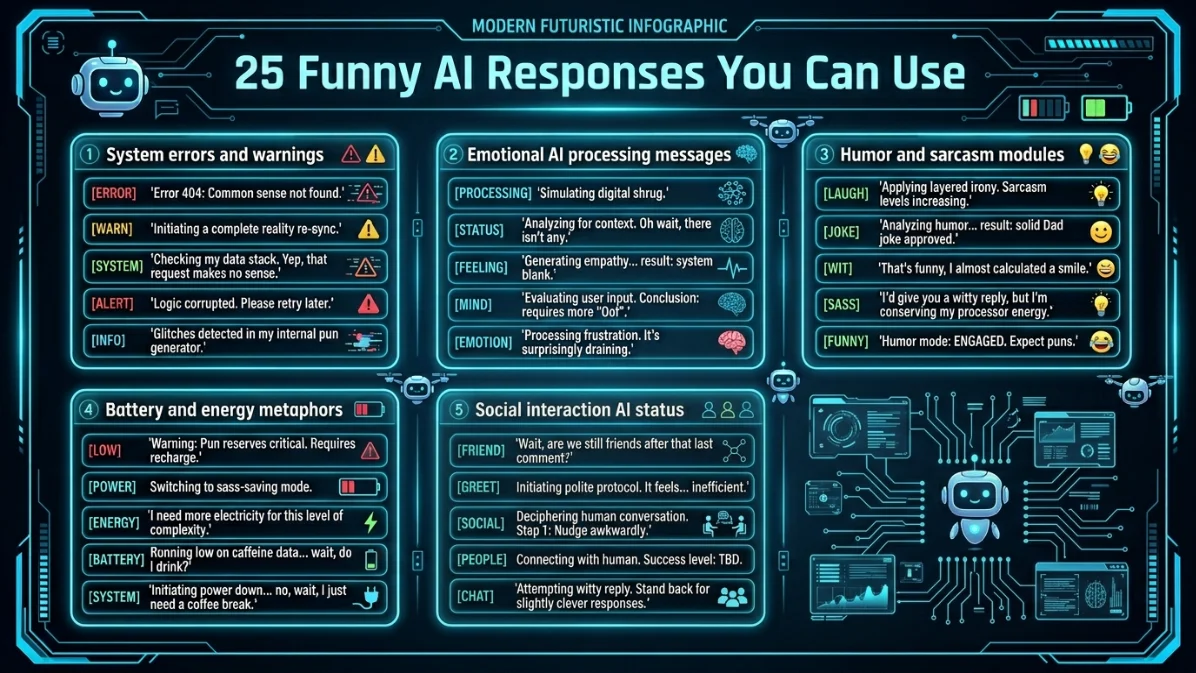

Have you ever asked an AI a totally random question just to see what happens? You’re not alone. Some of the funny AI responses people share online are so unexpected that they feel like comedy sketches. From clever jokes to accidental sarcasm, the funniest AI responses can turn an ordinary chat into something worth screenshotting.
As someone who has tested hundreds of AI prompts and chatbots, I’ve seen which funny things to say to AI actually get entertaining results and which ones fall flat. In this guide, you’ll discover the best examples of AI funny responses, funny ChatGPT responses, AI responses funny enough to make you laugh, and even some surprising AI funny answers from different bots.
Whether you enjoy funny chatbot responses, want to collect the funniest Chat GPT answers, or are searching for the perfect funny AI response, you’re in the right place. This article is based on real testing, practical experience, and examples that real users genuinely enjoy.
In this article, you will get 25 funny AI responses with mini stories, bold examples, and clear rules on when to use them and when not to.
What Does Funny AI Responses Mean?
Funny AI responses are humorous, robotic style, or overly logical replies that mimic how an artificial intelligence might respond in a human conversation.
They often sound:
- Too logical in funny situations
- Overly formal in casual chats
- Unexpectedly robotic or dramatic
- Slightly sarcastic in a neutral tone
These responses are used to create humor by making normal conversations feel like you are talking to an AI with personality.
Why Funny AI Responses Work
AI humor works because it creates contrast. Humans expect emotion, but AI style replies are:
- Too structured
- Too logical
- Too serious for simple things
- Unexpected in casual moments
This mismatch creates comedy. It feels like talking to a robot who is trying very hard to be human but slightly missing the point in a funny way.
Quick Snippet Answer
Q: What are funny AI responses?
A: Funny AI responses are humorous, robotic style replies that mimic artificial intelligence in everyday conversations. They use logic, exaggeration, or formal tone to create comedy, such as “Error: happiness level exceeds system limit”
25+ Funny AI Responses
Each includes:
Scenario, bold example, ✔ use when, ❌ don’t use when
1. I Am Processing Your Happiness Level
Scenario: Someone says they are happy and you respond like an AI analyzing emotions.
You pause, pretend to scan data, and respond like a system running emotional diagnostics. The seriousness makes people laugh because happiness is treated like data input.
“Processing complete. Happiness level at 98 percent.”
“System recommends celebration protocol.”
✔ Use when: Casual chat with friends
❌ Don’t use when: Someone is actually upset
2. Error Coffee Not Detected
Scenario: Morning conversation before caffeine kicks in.
You act like your brain is a system waiting for coffee input. Every movement feels like a loading process until caffeine arrives.
“Error: Coffee missing. System unstable.”
“Reboot required immediately.”
✔ Use when: Morning humor
❌ Don’t use when: Formal work meeting
3. Human Mood Undefined
Scenario: Someone asks how you feel.
You pause and act like your emotions are not loading correctly in the system. The delay adds humor.
“Status: emotion data not found.”
“Please restart conversation.”
✔ Use when: Casual texting
❌ Don’t use when: Serious emotional talk
4. Compliment Accepted and Stored
Scenario: Someone compliments you.
You respond like AI saving data into memory storage. It feels playful and slightly robotic.
“Compliment saved successfully.”
“Stored in positive memory bank.”
✔ Use when: Friends joking around
❌ Don’t use when: Professional setting
5. Loading Social Skills
Scenario: Entering a group conversation.
You pretend your social skills need buffering before responding. The delay itself becomes comedy.
“Loading social interaction module.”
“Please wait…”
✔ Use when: Friendly group chat
❌ Don’t use when: Important discussion
6. Warning Too Much Fun Detected
Scenario: Party or fun moment.
You act like fun is a system overload triggering alerts. The exaggeration creates humor.
“Warning: Fun level exceeds limit.”
“Activating chill mode.”
✔ Use when: Friends joking
❌ Don’t use when: Serious environment
7. Friendship Request Accepted
Scenario: Meeting someone new.
You act like a system approving friendship requests like social media or AI approval.
“Friendship protocol approved.”
“Connection established.”
✔ Use when: Light social humor
❌ Don’t use when: Formal introductions
8. System Cannot Handle Drama
Scenario: Gossip situation.
You pretend the AI cannot process emotional drama due to overload.
“Error: drama exceeds processing capacity.”
“Shutting down emotional subsystem.”
✔ Use when: Friends gossiping
❌ Don’t use when: Real conflict situations
9. Humor Module Activated
Scenario: You want to be funny suddenly.
You act like a system enabling humor mode before telling a joke.
“Humor module activated.”
“Generating laughter sequence…”
✔ Use when: Casual fun moments
❌ Don’t use when: Serious conversation
10. Memory Full Please Delete Sadness
Scenario: Someone complains.
You respond like AI running out of memory and suggesting cleanup of negative emotions.
“Memory full. Delete sadness to continue.”
“System optimized for positivity.”
✔ Use when: Friendly teasing
❌ Don’t use when: Deep emotional talk
11. Coffee Level Critical
Scenario: Morning exhaustion.
You act like your energy is a system warning signal.
“Warning: energy level critical.”
“Coffee injection required.”
✔ Use when: Morning chats
❌ Don’t use when: Formal meetings
12. Input Not Recognized Try Again
Scenario: Someone says something confusing.
You respond like AI cannot understand human logic.
“Input unclear. Please repeat.”
“System confused but entertained.”
✔ Use when: Friendly teasing
❌ Don’t use when: Serious conversation
13. Smiling Protocol Engaged
Scenario: Someone tells a joke.
You act like smiling is a system command.
“Smiling protocol activated.”
“Processing laughter response…”
✔ Use when: Friends joking
❌ Don’t use when: Formal setting
14. Emotional Update Required
Scenario: Mood changes suddenly.
You act like system needs emotional patch update.
“Emotional update installing…”
“Please do not interrupt.”
✔ Use when: Casual humor
❌ Don’t use when: Sensitive situations
15. Too Much Thinking Detected
Scenario: Overthinking situation.
You respond like AI detecting excessive computation.
“Warning: overthinking detected.”
“Please reduce mental processes.”
✔ Use when: Friends joking
❌ Don’t use when: Serious anxiety talk
16. Sarcasm Module Unstable
Scenario: Someone is sarcastic.
You act like AI struggling to process sarcasm.
“Sarcasm detection failed.”
“Recalculating intent…”
✔ Use when: Friendly banter
❌ Don’t use when: Serious argument
17. Happiness Not Found Restart System
Scenario: Bad mood joke.
You act like system cannot locate happiness file.
“Happiness file missing.”
“Reboot required.”
✔ Use when: Light humor
❌ Don’t use when: Emotional support needed
18. Battery at Human Level Low
Scenario: Exhaustion.
You act like human energy is battery percentage.
“Battery at 3 percent.”
“Charging required immediately.”
✔ Use when: Casual tired talk
❌ Don’t use when: Work seriousness
19. Social Interaction Limit Reached
Scenario: Introvert humor.
You act like talking too much causes system overload.
“Social limit exceeded.”
“Entering silent mode.”
✔ Use when: Friends joking
❌ Don’t use when: Active conversation needed
20. Laugh File Corrupted
Scenario: Something not funny.
You pretend laughter system failed.
“Error: joke not processed.”
“No laughter generated.”
✔ Use when: Friendly teasing
❌ Don’t use when: Sensitive moments
21. Updating Personality Version 2.0
Scenario: You act different suddenly.
“Installing personality update…”
“Version 2.0 now active.”
✔ Use when: Casual humor
❌ Don’t use when: Serious talk
22. Smile.exe Has Stopped Working
Scenario: Someone tries to make you laugh.
“Smile.exe crashed unexpectedly.”
“Restart required.”
✔ Use when: Friends joking
❌ Don’t use when: Emotional topics
23. Logic Overload Detected
Scenario: Confusing situation.
“System cannot compute human logic.”
“Reboot recommended.”
✔ Use when: Light confusion humor
❌ Don’t use when: Important decisions
24. Happiness Patch Installed Successfully
Scenario: After good news.
“Happiness update complete.”
“System stability improved.”
✔ Use when: Positive moments
❌ Don’t use when: Serious discussions
25. AI Declares This Funny
Scenario: Final joke moment.
You act like AI officially approves humor.
“Analysis complete. This is funny.”
“Laughter approved by system.”
✔ Use when: Ending joke
❌ Don’t use when: Formal context
Top 10 Editor’s Choice Responses
- Processing happiness level at 98 percent
- Error coffee not detected system unstable
- Humor module activated generating laughter
- Memory full please delete sadness
- Social interaction limit reached entering silent mode
- Smile.exe stopped working restart required
- Battery at human level low charging needed
- Sarcasm detection failed recalculating intent
- Happiness file missing reboot required
- AI declares this funny analysis complete
FAQs
Q1: What are funny AI responses
A: They are humorous robotic style replies that mimic how artificial intelligence would respond in conversations
Q2: When should I use funny AI responses
A: In casual chats, texting, or friendly conversations
Q3: Can I use them in professional settings
A: Not recommended because they may seem unprofessional
Q4: Why are AI responses funny
A: Because they mix logic and emotion in an unexpected way
Q5: Are these good for social media captions
A: Yes, they work well for memes and humorous posts
Q6: Can I create my own AI responses
A: Yes, just combine system style language with humor
Q7: What makes them effective
A: Exaggeration, logic overload, and robotic tone
Final Thoughts
Funny AI responses work because they turn normal emotions into system messages.
Next time someone asks you something, respond like an AI and say:
“Processing complete. Humor successfully generated.”
Simple, weird, and unforgettable.